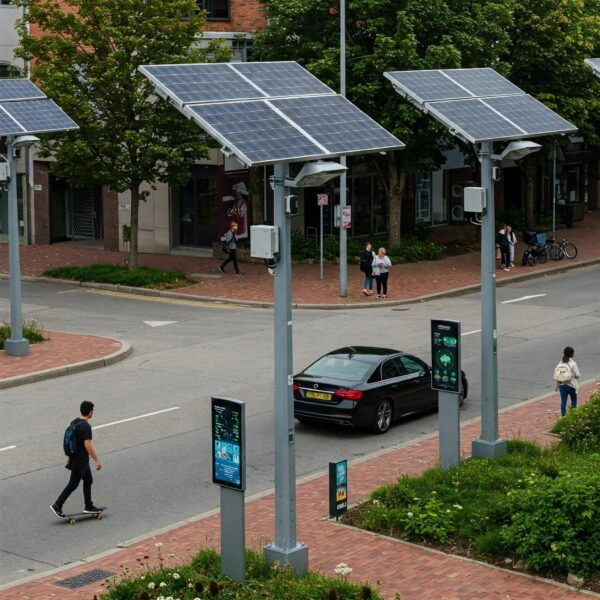



Across the Philippines, barangay halls, municipal roads, plazas, schools and evacuation centers are being lit with solar street lights instead of grid-powered ones — and for good reason. Many project sites sit far from existing distribution lines, extension costs can exceed the cost of the lights themselves, and brownouts make grid supply unreliable exactly when illumination matters most. For LGUs and barangay councils, a well-specified solar street light is not just a lamp: it is a self-powered infrastructure asset that keeps working through grid interruptions.
This guide is written for the people who actually buy these lights — municipal engineers, LGU procurement officers, government contractors and the EPC teams serving them. It covers why solar fits Philippine project conditions, the specifications that appear in serious bid documents, how typhoon and heat exposure change the design, and the factors that move a quotation up or down. Where a figure depends on your site and supplier, we say so instead of inventing one.
Why Solar Street Lights Fit LGU and Barangay Projects
- No trenching, no cabling, no monthly bill. The luminaire, panel, battery and controller ship as one integrated unit (or one kit), so installation is a pole, a foundation and the light. That matters where asphalt is new, ground conditions are hard, or the budget line for electrical works simply does not exist.
- Immunity to brownouts. A solar street light stores its own energy. During a grid outage it keeps operating on the same schedule — which is precisely when streets, plazas and evacuation routes need light.
- Off-grid reach. Rural roads, coastal barangays, islands and mountain sites can be lit without waiting for grid extension. Distance from the nearest utility pole stops being a constraint.
- Predictable operating cost. After installation the system runs on sunlight. The maintenance conversation becomes battery lifecycle and cleaning, not energy tariffs.
What Philippine Bid Documents Typically Specify
Specifications vary by project, but well-prepared bid documents for Philippine LGU and barangay procurement converge on a common core. The table below summarises what buyers commonly require and why it matters on site:
| Component | What bid documents commonly require | Why it matters in the Philippines |
|---|---|---|
| Battery chemistry | Lithium iron phosphate (LiFePO4) | Cycle life and heat tolerance suit a hot, humid climate far better than lead-acid. |
| Ingress protection | IP65 or better for the luminaire | Monsoon rain, driven spray and dust demand a sealed optical chamber. |
| Autonomy | Stated nights of backup on a full charge (project-defined) | Determines performance through consecutive overcast and storm days. |
| Light output | Delivered luminaire lumens, not LED chip lumens | Prevents paper specifications that under-deliver on the road surface. |
| PV module | Monocrystalline panel with stated wattage | Higher conversion efficiency keeps charging viable under tropical haze. |
| Controller | Programmable charge/discharge modes with light and time control | Allows dusk-to-dawn or timed profiles that match barangay ordinances. |
| Pole and mounting | Galvanised pole with wind load appropriate to the site | Coastal wind and typhoon exposure drive pole strength and foundation design. |
| Warranty | Written warranty terms with clear coverage per component | LGU assets must remain serviceable years after the ribbon-cutting. |
If you are preparing or reviewing a technical specification, our solar street light specification checklist for government tenders breaks each of these lines into the exact wording a bid document should contain.
All-in-One or Split: Matching the Configuration to the Site
Philippine projects use two configurations, and choosing correctly avoids rework:
- All-in-one (integrated) lights combine panel, battery, luminaire and controller in a single housing. They install in under an hour per unit, are easy to transport to island and mountain sites, and suit barangay roads, plazas, walkways and perimeter lighting. For interior roads and community areas they are the default choice.
- Split (separated) systems place the panel and battery separately from the luminaire. They suit higher-power applications, sites where the panel should face a specific solar orientation, and locations where separate components simplify future servicing and battery replacement.
Both configurations remain available on the same project because each suits different sites: Qichenshop supplies both lines, including the A02 all-in-one series and the A01 split series, so the configuration follows the site rather than the catalogue.
Typhoon, Heat and Humidity: Design Factors That Decide Lifespan
The Philippines puts solar street lights through conditions that mild-climate markets never see. Three environmental factors should shape any purchase decision:
- Wind and typhoon load. Ask suppliers for the wind load rating of the pole and bracket assembly, and match foundation design to the site’s exposure — coastal and ridge roads see far higher gusts than sheltered interior streets. During typhoon season, a folded or easily-serviced bracket design also simplifies pre-storm checks.
- Heat and battery life. Sustained high temperatures are the main enemy of battery lifespan. This is the strongest technical argument for LiFePO4 chemistry in tropical projects, and for a battery placed in a ventilated compartment rather than buried under the panel where heat accumulates.
- Humidity, salt and rain. Sealed enclosures (IP65 or better), corrosion-protected poles and drainage-friendly mounting keep water out of electronics. In coastal barangays, ask explicitly about salt-spray corrosion protection.
How Barangay and LGU Procurement Usually Runs
Public procurement in the Philippines follows the government procurement framework, and while every LGU administers it slightly differently, the shape is familiar: a project needs are documented in a project procurement management plan and funded through an appropriation; the bid documents define technical specifications, delivery and installation requirements; suppliers are evaluated on compliance, not just price; and delivery ends with inspection and acceptance against the approved specification.
Two practical lessons follow for suppliers and buyers alike. First, the specification is the contract: every performance claim a supplier makes should appear in the bid document, with units and test references, so acceptance inspection has something objective to check. Second, documented manufacturing capability matters: buyers increasingly ask for factory information, production photos and warranty terms in writing — which favours manufacturers with a verifiable track record over trading companies.
What Actually Drives the Price of a Solar Street Light
Quotations for nominally similar 6-metre and 8-metre solar street lights vary widely, and usually the difference is real — it is in the hardware. When you compare offers, expect price to move with:
- Battery chemistry, capacity and stated nights of autonomy — the single largest cost driver.
- PV panel wattage and cell quality.
- Delivered lumens and LED brand grade of the luminaire.
- Pole height, wall thickness, galvanisation and wind rating.
- Controller features (timing profiles, motion sensing, monitoring).
- Certification and testing requirements attached to the project.
- Order quantity, shipping terms and delivery destination.
Because these inputs differ per project, a responsible supplier quotes from your specification rather than a one-size price list. If you are building a shortlist, send the same specification to each supplier and compare line by line — the wattage, pole height and spacing guide helps you sanity-check whether the quoted configuration is even internally consistent for your road width and mounting height.
Questions to Ask Before You Award
- Is the quoted light output delivered luminaire lumens or LED chip lumens?
- What is the battery chemistry, capacity, and stated autonomy on a full charge?
- What wind load is the pole and bracket assembly rated for, and what foundation is recommended?
- What exactly does the warranty cover, per component, and for how long?
- Are spare parts (batteries, controllers, drivers) available years after purchase?
- Can the supplier provide factory information, production records and test reports?
- What certifications apply to the shipment, and who handles them?
On certifications: products entering the Philippines may be subject to Bureau of Philippine Standards schemes such as PS licensing or ICC import clearance depending on the product category and import channel. These regimes change and interpretation varies, so confirm the current requirement with your customs broker and raise it with your supplier early in the tender process rather than at the port.
How Qichenshop Supports Philippine Government Projects
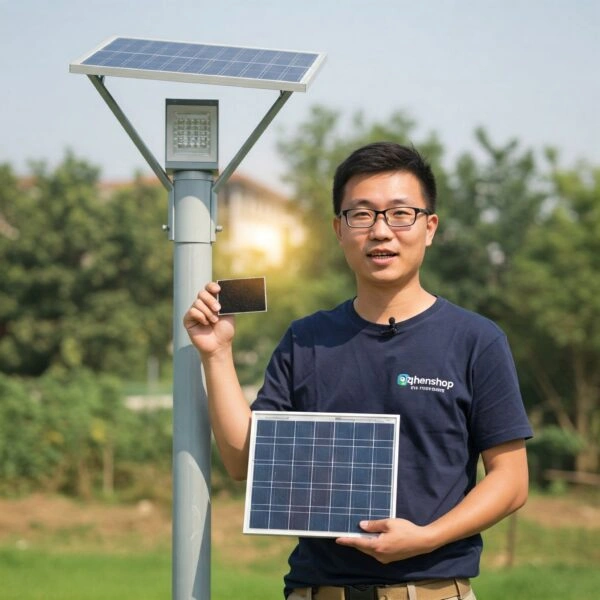
Qichenshop is the export brand of Jiangmen Qichen Lighting, a solar and LED lighting manufacturer in Guangdong, China — operating since 2010 and first registered as Zhongshan Qichen in 2013. We manufacture both all-in-one and split solar street light lines — 28 models across the range — with LiFePO4 battery options and IP65-rated luminaires, and we supply government contractors, wholesalers and installers across Southeast Asia.
- Specification support: project-specific configuration, photometric data and technical documentation for bid documents.
- OEM/ODM: custom branding and configuration from 50 units minimum order.
- Commercial terms: T/T 30% deposit and 70% before shipment; typical production lead time of 15 days; a 5-Year Limited Warranty with written component coverage.
Planning a barangay, municipal or private-sector lighting project in the Philippines? Send us your road width, mounting height, required nights of autonomy and target quantity — we will return a configuration and quotation, usually within one working day. Contact Qichenshop for a project quotation, or browse the full product catalogue.