MPPT vs PWM Solar Charge Controllers in Solar Street Lights
By
/ November 13, 2026
MPPT vs PWM Solar Charge Controllers in Solar Street Lights
The solar charge controller sits between the panel, the battery and the luminaire, and it decides how much of the energy your panel actually harvests reaches the battery. In solar street lights the panel is deliberately small and the battery runs a deep nightly cycle, so the controller choice has a bigger impact on winter and cloudy-season autonomy than most buyers expect. This guide compares the two dominant types, PWM and MPPT, shows where each one makes sense, and lists what to specify before you award an order.
Why the Controller Matters More in Street Lights Than in Small Solar Gadgets
A garden light can tolerate an inefficient charge profile because a partially charged battery still lights a low-power LED. A street light cannot. It must run at full output for a fixed nightly schedule, several hours after sunset, and it must recover the next day from a deep discharge. When harvest efficiency drops, the first casualty is autonomy: the battery never returns to full charge, low-voltage disconnect triggers earlier each night, and the luminaire starts dimming or switching off long before the warranty conversation begins.
That is why serious buyers treat the controller as a specified component with its own line in the datasheet, not as an anonymous black box inside the luminaire. It is also why controller type belongs next to battery chemistry in any solar street light specification checklist.
How a PWM Controller Works
A PWM (pulse-width modulation) controller is essentially a fast electronic switch between the panel and the battery. When the battery needs charging, the switch closes and the panel is pulled down to operate at roughly the battery voltage. Any panel voltage above the battery voltage is not converted into extra current; it is simply not harvested.
The consequence: a PWM controller only makes full use of the panel when the panel voltage is close to the battery voltage. With a 12V battery and a panel whose maximum power voltage sits near 17 to 18V, the gap between where the panel wants to operate and where the controller forces it to operate is wasted potential. PWM compensates with simplicity: fewer components, low cost, decades-proven reliability, and low standby consumption.
How an MPPT Controller Works
An MPPT (maximum power point tracking) controller is a DC-DC converter with a tracking algorithm, commonly a perturb-and-observe method, that continuously adjusts its operating point to keep the panel at its maximum power voltage. The surplus voltage is converted into additional charging current instead of being discarded. The panel keeps working where it is most productive; the battery receives what the panel actually harvested.
The practical gain depends on conditions. As a widely used industry rule of thumb, MPPT harvests roughly 10 to 30 percent more energy than PWM in the same system, with the high end reached when the panel voltage sits well above battery voltage and temperatures are low. In hot climates where panel voltage sags and the panel-to-battery gap is narrow, the gain can be modest. Anyone quoting a fixed gain number for all climates is selling a slogan, not a measurement.
Side-by-Side Comparison
Aspect
PWM
MPPT
Operating principle
Switch connecting panel to battery; panel runs at battery voltage
DC-DC converter tracking the panel maximum power point
Panel voltage use
Voltage above battery level is wasted
Surplus voltage converted into charging current
Typical harvest
Baseline
About 10 to 30 percent more, conditions dependent
Best panel match
Panel voltage close to battery nominal voltage
Panels with higher voltage, series strings, or cool climates
Cost and complexity
Low cost, simple, proven
Higher cost, more components
Failure behaviour
Failures usually benign, charging simply stops
More electronics; quality sourcing matters
Typical fit
Small luminaires, tight panel-to-battery match, cost-driven volumes
Larger luminaires and projects where cloudy-season autonomy is critical
Matching the Controller to the Luminaire Power Class
Controller selection should follow the energy budget of the luminaire, not the other way around. The table below is a selection framework, not a product claim; always confirm the final configuration against the datasheet of the specific model.
Luminaire class
Typical energy reality
Controller consideration
20 to 40W compact luminaires
Small panel, small battery, short nightly schedule
PWM can be acceptable where panel voltage closely matches the battery and budget is tight
60 to 80W mainstream street lights
Panel-to-battery gap exists, autonomy targets 2 to 3 nights
MPPT usually earns its cost premium through extra harvest
100W and above, high-mast or arterial roads
Large nightly energy draw, every watt-hour counts
MPPT strongly preferred; ask for the controller rated charge current versus panel short-circuit current
For lithium LiFePO4 packs, the controller must also implement a lithium charge profile with correct bulk, absorption and float stages and reliable low-voltage disconnect. Controller type and battery chemistry are separate decisions; do not accept “lithium ready” as a substitute for a written charge profile. Our LiFePO4 vs lead-acid comparison covers the battery-side trade-offs in detail.
The Marketing Trap: Tracking Efficiency Is Not Harvest Gain
Datasheets often advertise 98 or 99 percent efficiency for MPPT controllers. That figure describes the DC-DC conversion efficiency, how little energy is lost inside the converter, not how much more energy you harvest compared with PWM. A controller can be 99 percent efficient at conversion and still only deliver a small real-world gain if the panel and battery voltages are closely matched.
When comparing quotes, the questions that separate engineering from marketing are: what is the panel maximum power voltage versus the battery nominal voltage, what is the controller rated charge current against the panel short-circuit current, and does the vendor state expected harvest gain for your climate or just the conversion percentage. These same questions belong in the pricing conversation covered in our guide to comparing quotes fairly.
Questions to Put in Your RFQ
Controller type: MPPT or PWM, stated explicitly in the datasheet, not inferred.
Rated charge current versus panel short-circuit current, so the controller is never the bottleneck.
Battery chemistry support: a written lithium LiFePO4 charge profile with low-voltage disconnect and temperature compensation.
Load control modes: dusk-to-dawn photocell, timer schedules, and motion sensor behaviour.
Protection list: reverse polarity, overload, short circuit, and panel reverse current at night.
Whether the controller settings are documented and adjustable for your project schedule.
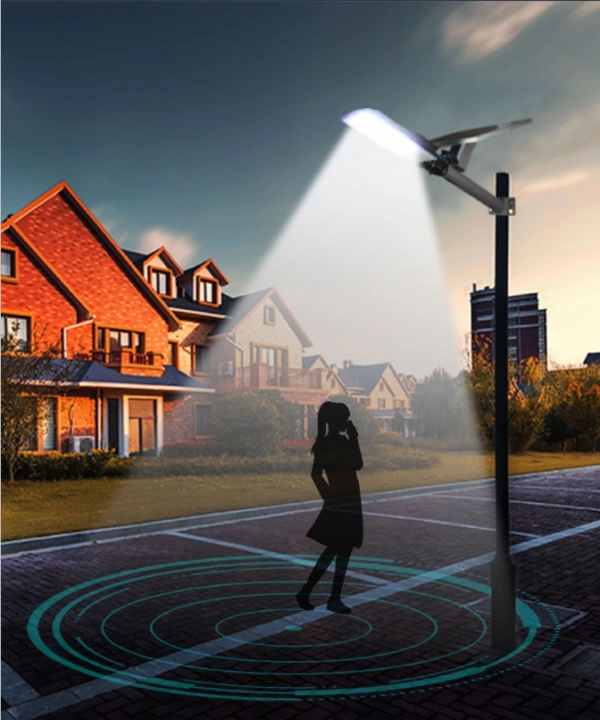
Control modes deserve one clarification. Our luminaires ship with dusk-to-dawn photocell control, timer scheduling and microwave radar motion sensing as standard. Higher-level smart city integrations, including NEMA or Zhaga sockets and Wi-SUN mesh networking, are available as optional or customizable integration, not as standard equipment. The full picture is in our smart control options article.
What Qichenshop Provides
Qichenshop (Jiangmen Qichen Lighting Co., Ltd., manufacturing solar lighting since 2010, first registered as Zhongshan Qichen in 2013) supplies solar street lights with the controller and battery configuration matched per model, documented in a per-model datasheet. If your tender requires a specific controller type, rated current or charge profile, state it in your RFQ and we will confirm in writing what the specified models support. We do not inflate controller claims to win a comparison; see our lithium battery shipping guide for how we handle import documentation and technical files.
Both the A21 all-in-one solar street light and the A01 split solar street light are documented with their battery configuration so you can evaluate the energy budget yourself before requesting a quote.
Working With Qichenshop
Minimum order quantity starts from 50 units, with payment terms of 30 percent T/T deposit and 70 percent balance before shipment. Standard production lead time is typically 15 days, and customized configurations run 15 to 25 days. Quotations are valid for 30 days. Our sample programme is USD 50 for OEM and USD 300 for ODM plus freight collect, refundable against a first order of USD 1,000 or more. All outdoor luminaires are rated IP65 and backed by a 5-Year Limited Warranty.
Ready to specify the controller for your next project? Contact Qichenshop with your panel voltage, battery chemistry and nightly schedule, and our engineers will return a configuration that matches the numbers.
To provide the best experiences, we use technologies like cookies to store and/or access device information. Consenting to these technologies will allow us to process data such as browsing behavior or unique IDs on this site. Not consenting or withdrawing consent, may adversely affect certain features and functions.
Functional
Always active
The technical storage or access is strictly necessary for the legitimate purpose of enabling the use of a specific service explicitly requested by the subscriber or user, or for the sole purpose of carrying out the transmission of a communication over an electronic communications network.
Preferences
The technical storage or access is necessary for the legitimate purpose of storing preferences that are not requested by the subscriber or user.
Statistics
The technical storage or access that is used exclusively for statistical purposes.The technical storage or access that is used exclusively for anonymous statistical purposes. Without a subpoena, voluntary compliance on the part of your Internet Service Provider, or additional records from a third party, information stored or retrieved for this purpose alone cannot usually be used to identify you.
Marketing
The technical storage or access is required to create user profiles to send advertising, or to track the user on a website or across several websites for similar marketing purposes.