


“Smart” Means Different Things to Different Suppliers
Ask five suppliers for a “smart solar street light” and you will receive five different products. One ships a fixture with a dusk-to-dawn photocell and calls it smart. Another adds a motion sensor. A third quotes a networked system with a central management platform, a per-light monthly subscription and a two-year integration project. All three appear on the same comparison spreadsheet at a tender, and the differences only surface after delivery.
This article separates the control options for solar street lights into what they do, how they behave at night, and which of them require engineering work versus which ship as configuration. Read it before you write “smart control” into a specification, because that phrase alone leaves too much room for interpretation.
What Comes Standard: Photocell, Timer and Motion Sensor
On our production line, three control functions ship as standard equipment on every solar street light, from a 30W to 120W all-in-one model like the A21 to a split configuration such as the A01:
- Light control (dusk to dawn): the fixture switches on at sunset and off at sunrise based on ambient light level. No programming, no schedule to maintain, and it self-corrects through the seasons as day length changes.
- Timer control: the nightly operating window is set by schedule. This is how you implement common profiles such as full output for the first hours, reduced output overnight, and full output again before dawn.
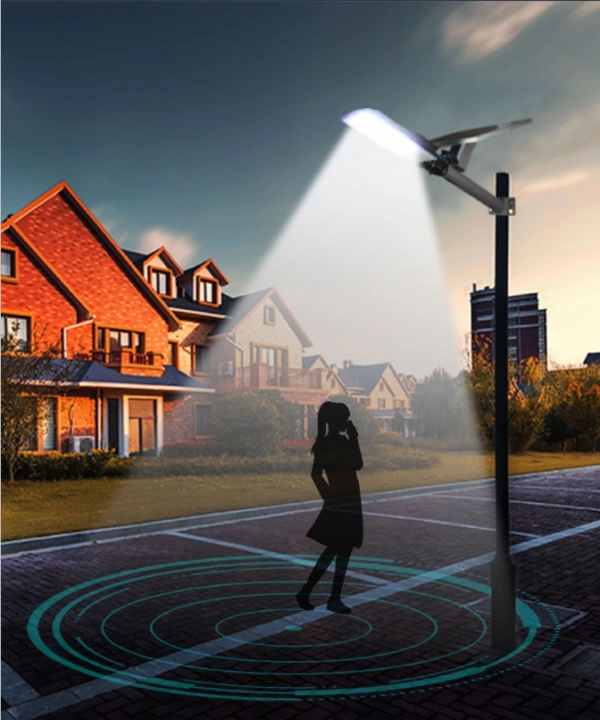
- Microwave radar motion sensor: when no movement is detected, the fixture dims to a preset level; a passing pedestrian or vehicle brings it back to full output within a defined radius and hold time.
These three functions cover the operating logic of most municipal, compound and perimeter projects. They are configuration, not engineering: set at the controller before shipment or adjusted in the field, with no network infrastructure, no data plan and no recurring cost.
A Typical Nightly Profile Combining All Three
A common configuration for a residential road: lights on at dusk via light control, full output for the first four hours by timer, then 30 percent output with the radar sensor active. The sensor raises output to full when traffic is detected and drops it again after the hold time expires. At sunrise, light control switches the fixture off and charging begins.
Because the radar only draws meaningful power when traffic passes, this profile stretches battery autonomy significantly compared with running at full output all night. That matters in the rainy season, which is exactly when buyers in the Philippines and Nigeria need the margin most.
Why Microwave Radar Instead of PIR
Passive infrared (PIR) sensors detect heat from moving bodies and work well at short range, but their detection cone narrows with mounting height and they lose sensitivity in hot ambient conditions. Microwave radar emits a low-power radio field and detects movement through its reflection, so it performs consistently at typical street light mounting heights and is indifferent to ambient temperature. For street lighting, radar is the more reliable detection method, which is why it is the sensor we fit as standard.
Dimming and Scheduled Profiles
Timer control is also the mechanism behind dimming schedules. Rather than a single fixed output, the controller can follow a multi-stage nightly curve set as a percentage of rated output. Common use cases include compound perimeters that need low background light all night with full boost on sensor trigger, and arterial roads that need full output only during known traffic peaks.
When you compare quotations, confirm that dimming profiles are configurable per fixture rather than locked to one factory preset. The profile is the single biggest lever on battery sizing and therefore on system cost, a point our guide on solar street light price factors covers in the controller section.
Networked Control: NEMA, Zhaga and Wi-SUN
Beyond the standard sensor functions sits a second tier: fixtures that report to and receive commands from a central management system. This tier uses standardized interfaces, and the three names you will encounter in tender documents are NEMA, Zhaga and Wi-SUN. None of them is a product. They are socket formats and communication protocols that let equipment from different vendors interoperate.
NEMA Socket
The NEMA socket, standardized under ANSI C136.41 as a seven-pin locking receptacle, is the twist-lock interface mounted between the luminaire and its control gear. A photovoltaic photocell, a wireless node or a sensor can all plug into the same socket. Its value is modularity: a node can be replaced or upgraded without opening the fixture. If your city already operates nodes on a specific network, requiring a NEMA receptacle keeps your fixture procurement compatible with that ecosystem.
Zhaga Book 18
Zhaga Book 18 is an interface specification from the Zhaga Consortium that standardizes how a sensing or communication node mounts, powers and communicates with the luminaire, including a defined locking mechanism and the electrical and data interface between node and fixture. In practice it plays the same role as the NEMA socket for the newer generation of multi-sensor nodes, and the two formats coexist across different markets. Specifying the socket format your chosen management platform supports is what matters, not the name itself.
Wi-SUN Mesh Networking
Wi-SUN (Wireless Smart Utility Network) is a mesh communication protocol, built on IEEE 802.15.4g radio, used by street lighting management platforms and utility networks. Each node relays traffic for its neighbors, so the network extends with fleet size and self-heals around a failed unit. That makes it well suited to city-scale deployments of thousands of points where a central dashboard, per-light fault alarms and remote dimming schedules justify the investment.
The Critical Phrase: Optional, Customizable Integration
Here is the sentence to hold onto when you read supplier datasheets: NEMA sockets, Zhaga nodes, Wi-SUN connectivity and smart-city platform integration are optional and customizable integrations on our fixtures, not standard equipment. Standard ships as photocell plus timer plus radar sensing. Networked operation is engineered per project, against the management platform your city or utility has already selected, and quoted with the hardware and configuration work it actually requires.
Any quotation that bundles a proprietary “cloud platform” into the base price without stating the network standard, the node hardware and the recurring data or license cost deserves a second look. Our guide on buying solar street lights wholesale from China lists platform assumptions among the items to force into the open during RFQ.
| Control Option | What It Does | Status on Qichenshop Fixtures | Best Suited To |
|---|---|---|---|
| Light control (dusk to dawn) | Automatic on/off at sunset and sunrise | Standard | Every project; baseline of any configuration |
| Timer control | Scheduled operating window and dimming stages | Standard | Runtime budgeting, dimming profiles, seasonal tuning |
| Microwave radar motion sensor | Presence detection, dim-to-bright behavior | Standard | Residential roads, compounds, perimeters, low-traffic hours |
| NEMA socket (ANSI C136.41) | Seven-pin twist-lock interface for plug-in nodes | Optional / Customizable integration | Cities standardizing on a node ecosystem |
| Zhaga Book 18 | Standardized node mounting and data interface | Optional / Customizable integration | Platforms specifying multi-sensor Zhaga nodes |
| Wi-SUN mesh | Self-healing mesh network for central management | Optional / Customizable integration | City-scale fleets under a management platform |
What Networked Control Actually Costs You
The hardware node is the visible cost, but not the only one. Budget for these before specifying networked control:
- Standby power: a communication module draws power around the clock, and that consumption must be included in the panel and battery energy balance, or runtime suffers in overcast weeks.
- Subscription and connectivity: management platforms typically carry per-light license or SIM/data costs that recur annually and outlive the purchase contract.
- Commissioning and integration: node provisioning, gateway installation and platform onboarding are project work, not plug-and-play.
- Dependency: remote schedules and fault alarms are only as good as network coverage and platform availability in your operating region.
None of this argues against smart control. It argues for matching the tier to the project: a 200-light barangay program rarely justifies a management platform, while a 5,000-light city corridor usually does. Choosing correctly is a procurement decision, and the section below gives you the questions to ask.
How to Specify Controls in Your RFQ
Replace the vague phrase “smart control” with explicit requirements. A controls paragraph that gets comparable bids looks like this:
- Standard operation: dusk-to-dawn light control, programmable timer with at least a multi-stage nightly dimming profile, and microwave radar motion sensing with adjustable sensitivity, detection radius and hold time.
- Profile set before shipment per project section, and field-adjustable without proprietary tools.
- Optional networked operation: state the required socket format (NEMA ANSI C136.41 or Zhaga Book 18), the communication protocol (for example Wi-SUN), and the target management platform, quoted as a separate line item.
- Energy balance: confirm the stated panel and battery sizing already includes the standby draw of any communication module.
Every bidder answering this grid quotes the same thing, which is the whole point. Our pre-shipment inspection checklist then verifies before loading that the shipped configuration matches the profile you specified.
How Qichenshop Configures Control
Standard configuration on all models: light control, timer control and microwave radar motion sensing, set to your project profile before shipment and adjustable in the field. Dimming schedules, sensor sensitivity and hold times are configured per section of your project, not per fleet.
For networked deployments, we treat NEMA sockets, Zhaga nodes, Wi-SUN connectivity and platform integration as optional, customizable integration: quoted against the platform your project uses, with node hardware, configuration work and energy balance impact stated as separate line items. We do not lock a proprietary platform into the base price.
Commercial terms are the same across configurations: minimum order quantity from 50 units, payment by T/T with 30 percent deposit and 70 percent against copy of B/L, standard production lead time of 15 days (15 to 25 days for customized configurations), and quotations valid for 30 days. Samples follow our OEM and ODM terms: OEM samples at USD 50, ODM samples at USD 300, freight collect, refundable against a first order of USD 1,000 or more.
If you are writing a specification for a tender or planning a pilot section, send us the project parameters and target control behavior. Request a control-configuration quotation from Qichenshop and we will return a per-model datasheet showing exactly which functions are standard and which are engineered options.