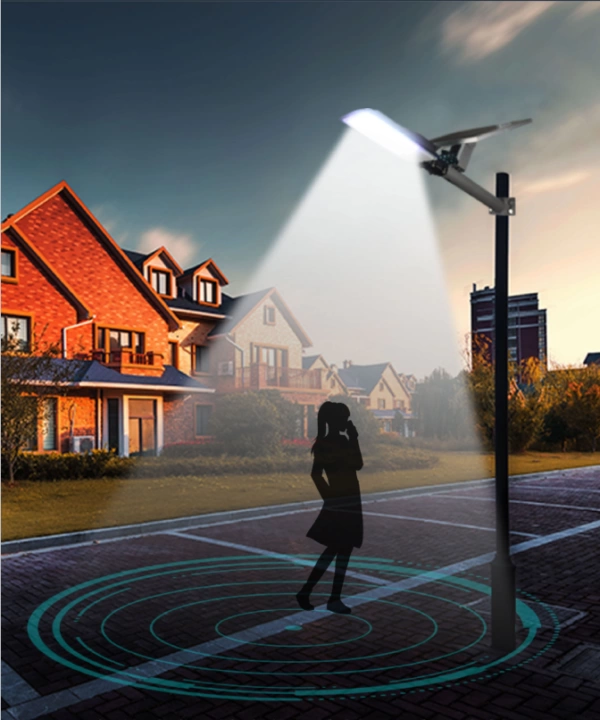



Flood light quotations often start with a wattage question: “How many watts do I need for a 200 m² yard?” It is an understandable question, but it is the wrong one. Two 100 W flood lights can differ by a factor of two or more in the light they actually deliver, because LED efficiency, optics, driver losses and housing design all vary between products. Buying by wattage is how projects end up with dark corners, glare complaints, or fixtures that are far larger — and more expensive — than the task requires.
This guide explains how to select LED flood lights the way lighting engineers do: by target illuminance (lux), delivered lumens and beam angle, then by the practical requirements that follow — IP rating, anti-glare design and flicker behaviour where CCTV cameras are involved. It is written for wholesalers, installers and EPC teams specifying flood lighting for courtyards, compounds, parking areas and sports courts in tropical markets such as the Philippines and Nigeria.
Start From the Application, Not the Catalogue
Every flood lighting project has three inputs: the area to be lit, the level of illuminance the activity needs, and the mounting positions available. Fix the first two from the application itself, then let the third shape the optics. A warehouse wall and a tennis court may cover similar areas, yet the tennis court needs roughly ten times more light on the surface, and the wall needs a narrow asymmetric beam while the court needs wide, overlapping coverage.
Recommended Illuminance Levels by Application
The table below lists typical target illuminance ranges used in outdoor flood lighting practice. They are planning values, not legislation — national standards and project specifications take precedence — but they are a reliable starting point for sizing quotes and for sanity-checking supplier proposals.
| Application | Typical Target Illuminance | Practical Notes |
|---|---|---|
| Residential courtyard / garden | 20–50 lux | Comfort and orientation; avoid glare toward windows and neighbours |
| Compound / perimeter security lighting | 30–50 lux (perimeter line) | Uniformity along the fence matters more than peak brightness |
| Parking areas (outdoor) | 20–50 lux | Check uniformity between parked cars; higher range for entrances and payment points |
| Loading bays / warehouse aprons | 100–200 lux | Working area — specify vertical illuminance where people handle goods |
| Facade / architectural lighting | 20–50 lux (light surfaces) up to 100 lux (dark surfaces) | Dark surfaces absorb more light; grazing angles reveal texture |
| Outdoor basketball court (recreational) | 150–200 lux | Uniformity is critical; poles should minimise shadows in playing zones |
| Tennis court (recreational) | 200–300 lux | Requires directed optics to keep light off the players’ sight lines |
Once the target lux is fixed, the required light output follows a simple logic: area × target lux ÷ utilisation factor ÷ delivered lumens per fixture = number of fixtures. A dedicated guide with worked lux calculations for courts and perimeters is on the way — or contact us and we will run the numbers for your site.
Why Lumens Beat Wattage
Wattage measures electrical input; lumens measure the light that leaves the fixture. LED efficacy has improved so much that a modern 100 W flood light can outperform an older 250 W metal halide unit, and two current LED products of the same wattage can still differ by 30–50% in delivered light because of optics, thermal design and driver quality.
- Ask suppliers for delivered lumens (or luminaire lumens), not chip lumens — chip figures ignore optical and thermal losses.
- Compare efficacy: delivered lumens divided by watts. Values around 100–150 lm/W are common for current LED flood lights; treat unusually high claims with caution.
- Check that the quoted lumens are backed by an IES or LDT photometric file for the exact model, so a DIALux simulation can verify the layout before purchase.
- Beware of marketing wattage: some housings are labelled with figures far above the real electrical load. A clamp meter test on a sample unit settles the dispute cheaply.
Choosing Beam Angle by Application
Beam angle decides where the lumens land. A wide beam spreads light over a large area at low intensity; a narrow beam concentrates it for tall mounting positions or long throws. Matching beam angle to mounting height and distance is the difference between an even field and a patchwork of hotspots and shadows.
| Beam Type | Typical Angle | Best For |
|---|---|---|
| Spot | 10–30° | Tall masts, long-throw facade accents, flagpoles, signage |
| Medium flood | 30–60° | Perimeter walls, mid-height facades, loading doors, single objects |
| Wide flood | 60–90° | Parking areas, compound yards, general area lighting at 4–8 m height |
| Very wide / asymmetric | 90–120° or asymmetric optics | Wall-mounted area lighting where fixtures must sit close to the lit surface |
For most perimeter and parking applications on 6–9 m poles, wide flood optics with overlapping spacing produce better uniformity than fewer fixtures with narrow beams. For building-mounted security lighting, asymmetric optics push light outward across the yard instead of washing the wall directly below the fixture.
IP Rating, Heat and Build Quality
Outdoor flood lights in the Philippines and Nigeria live with monsoon rain, coastal humidity, dust in the dry season and year-round heat. The ingress protection (IP) rating of the complete fixture — not just the LED module — should be IP65 or IP66 for exposed outdoor use. Heat management is the quieter failure mode: LEDs lose output and lifetime when the housing cannot dissipate heat, so look for die-cast aluminium housings with real fin area and a stated lumen-maintenance figure rather than sealed plastic bodies.
- IP65/IP66 on the assembled fixture for outdoor exposure; verify it is claimed for the whole luminaire, with test reference.
- Surge protection matters where grids are unstable — ask for the surge protection rating (kV) of the driver.
- For coastal sites, confirm the housing finish and fasteners are suitable for salt-laden air.
- Request an aging or burn-in test report for the offered model, not a sister product.
Anti-Glare and Flicker: Details That Show Up on Camera
Glare and flicker are the two complaints that appear after installation, when the invoice is already paid.
Glare: shielded optics, recessed LED positions and a sensible mounting angle keep light out of people’s eyes and neighbouring properties. In residential compounds and along roads, fixtures with a visible cut-off and moderate peak intensity are almost always preferable to raw-brightness units.
Flicker: where CCTV cameras cover the area, driver flicker can make footage strobe or roll. Specify drivers with low current ripple or high-frequency PWM dimming, and test one fixture against the site’s actual camera before mass deployment. Flicker percentage is normally stated in the driver datasheet — ask for it.
Solar Flood Lights: When They Make Sense
Solar flood lights eliminate trenching and cabling, which is decisive where the nearest power point is far away or the grid supply is unreliable — a common situation in off-grid and semi-urban Philippine and Nigerian sites. The selection logic above does not change: match delivered lumens and beam angle to the task, then size the panel and battery for the local sun conditions and required nightly run time, with autonomy for consecutive overcast days. The same principles we apply to solar street light sizing — wattage, pole height and spacing — are covered in our wattage and spacing guide.
For projects where mains power is already available and cheap, wired LED flood lights remain the simpler choice; for gates, perimeters and yards beyond cable reach, solar units avoid both the trench and the electricity bill.
How Qichenshop Supports Flood Light Projects
Qichenshop (Jiangmen Qichen Lighting) has manufactured outdoor lighting in Guangdong, China since 2010, first registered as Zhongshan Qichen in 2013. Alongside our solar street light range, we supply LED and solar flood lights for compound, perimeter and area lighting projects — see our product range for the current catalogue, and our factory profile for production and testing capability.
Wholesale and project orders start from a minimum of 50 units per model, typical production lead time is 15 days, and payment terms are 30% deposit by T/T with the balance before shipment. Certification documents for destination-market requirements are provided on request — we will confirm exactly what is available for the model you enquire about rather than promise what cannot be verified.
Planning a compound, court or perimeter lighting project? Contact the Qichenshop team with your area dimensions, mounting positions and target lux, and we will return a lumens-and-beam-angle proposal with the fixture count calculated for you.