


Most solar street light projects are not lost on LED efficiency. They are lost on the battery. A distributor who wins a 500-pole tender on a competitive price, using the wrong battery chemistry, will be replacing banks in year three — at their own cost, in front of the same client they are trying to win again. This guide compares the three chemistries you will actually be quoted on in 2026 — flooded lead-acid, gel, and LiFePO4 — and shows where the money really goes over a project’s life.
Why battery chemistry decides the project
In a solar street light, the battery has the shortest service life of any major component. The LED may run 50,000 hours. The panel has no moving parts. The controller is a sealed board. But the battery is an electrochemical device that degrades every single day, and it is the only component whose replacement you will have to plan and pay for.
That single fact changes how a quotation should be read. The relevant question is not “what does the battery cost?” but “how many times will I buy this battery before the pole reaches end of life?”
Cycle life and depth of discharge: the two numbers that matter
Two specifications determine how long a battery actually lasts:
- Cycle life — how many charge–discharge cycles the battery delivers before capacity falls to roughly 80% of its rated value.
- Depth of discharge (DoD) — how much of the rated capacity you are allowed to use per cycle without destroying cycle life.
These two multiply together. That product is the battery’s lifetime usable energy, and it is the only honest basis for comparison.
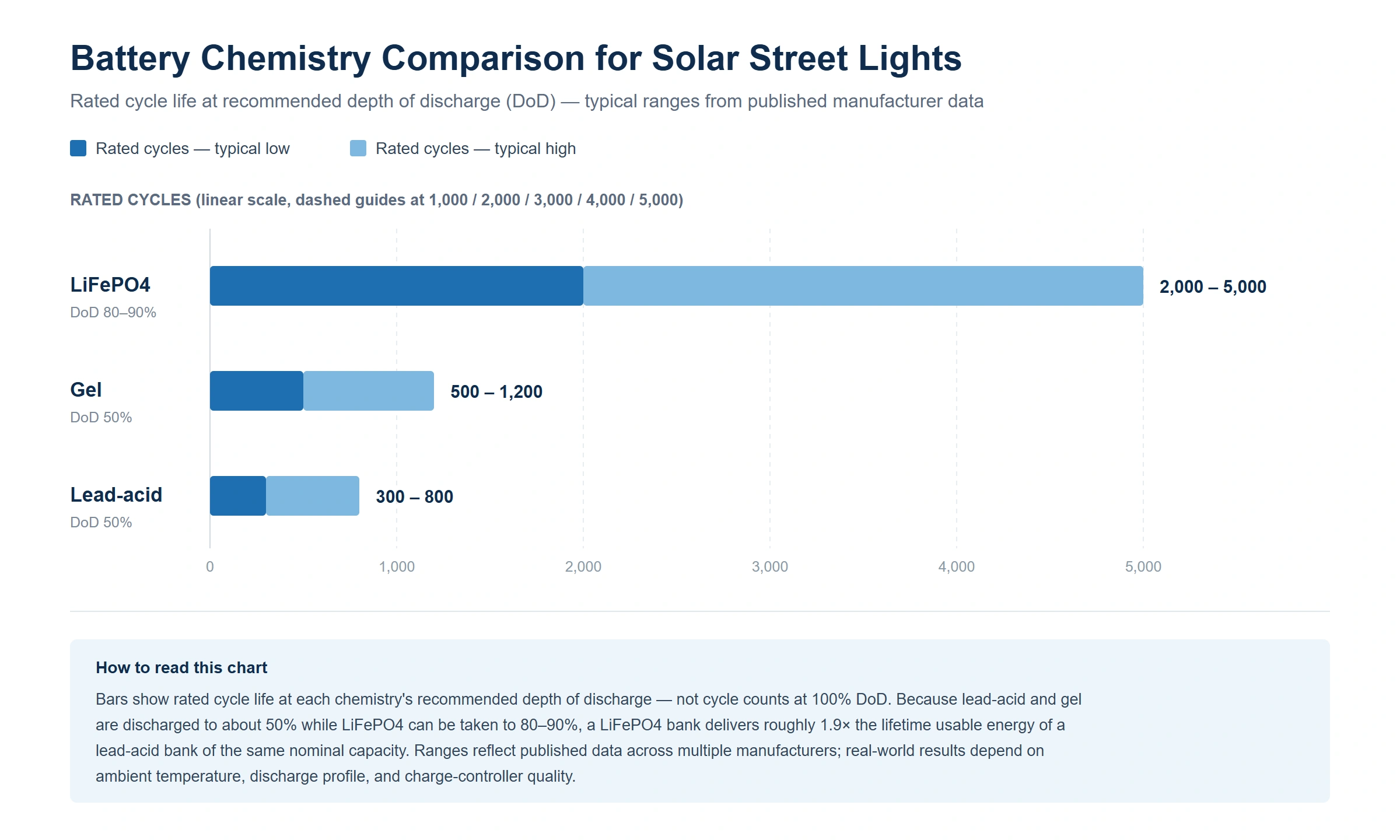
A lead-acid bank is typically limited to about 50% DoD. Discharge it deeper and cycle life collapses. A LiFePO4 bank will accept 80–90% DoD as normal operation. So a 100 Ah lead-acid battery gives you roughly 50 Ah of usable energy per cycle, while a 100 Ah LiFePO4 battery gives you 80–90 Ah. The nameplate capacity is the same. The delivered energy is not.
What this looks like in years
For a street light cycling once per day — which is the normal duty for a solar street light — the arithmetic is unforgiving:
| Chemistry | Recommended DoD | Lifetime usable cycles | Approximate calendar life at 1 cycle/day |
|---|---|---|---|
| Flooded lead-acid | 50% | 150 – 400 | 0.5 – 1 year |
| Gel | 50% | 250 – 600 | 1 – 2 years |
| LiFePO4 | 80 – 90% | 1,700 – 4,250 | 7 – 11+ years |
Those figures are the reason lead-acid is disappearing from any project with a design life beyond two years. It is not a question of quality. It is a question of how many times you are willing to send a crew to open a pole.
Full comparison across all decision criteria
| Parameter | Flooded lead-acid | Gel | LiFePO4 |
|---|---|---|---|
| Cycle life | 300 – 800 | 500 – 1,200 | 2,000 – 5,000+ |
| Usable energy per rated Ah | ~50% | ~50% | ~80 – 90% |
| Trend in export cost/kWh | Rising | Rising | Falling steadily |
| Energy density (Wh/kg) | 30 – 40 | 35 – 45 | 90 – 130 |
| Weight for 100 Ah @12.8 V | ~28 – 32 kg | ~30 – 34 kg | ~11 – 13 kg |
| Operating temperature | −15 to 45 °C | −20 to 50 °C | −20 to 60 °C |
| High-heat tolerance | Poor | Moderate | Good |
| Maintenance | Water top-up | Sealed | Sealed |
| Depth-of-discharge damage risk | High | Moderate | Low |
| Recyclability | High (mature) | Moderate | Improving |
| Best fit | Legacy low-cost | Budget sealed | Modern B2B projects |
The weight row deserves attention. A 100 Ah lead-acid bank weighs roughly 2.5 times the equivalent LiFePO4 bank. On a pole, that is extra structural load and a harder installation. In a shipping container, it is fewer units per container — a direct freight cost you pay on every order.
The real test: ten-year total cost of ownership
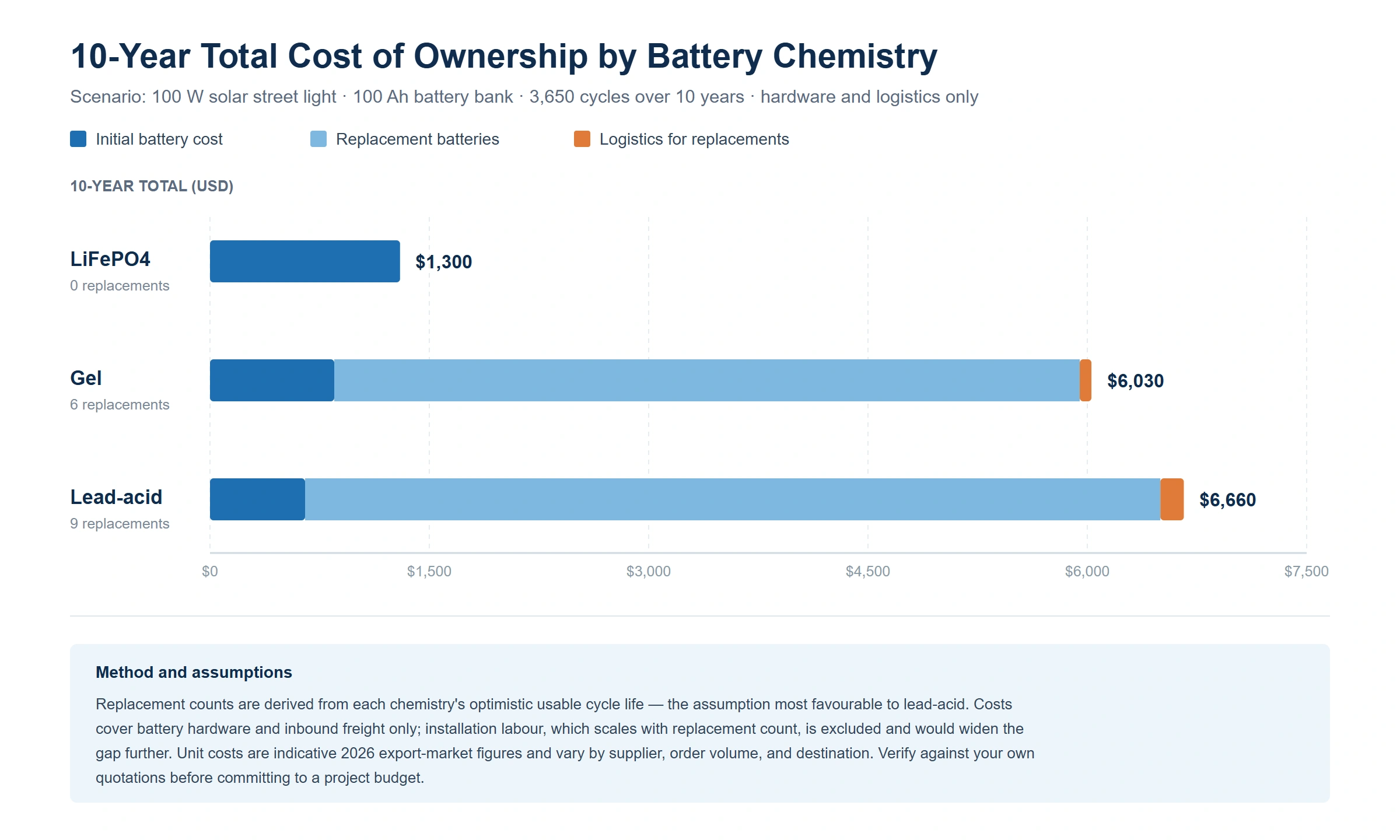
Up-front price is the least reliable metric in this comparison, because it ignores how many times the battery is bought. Model a 100 W solar street light with a 100 Ah battery bank over ten years — 3,650 cycles — and the picture inverts:
| Line item | Flooded lead-acid | Gel | LiFePO4 |
|---|---|---|---|
| Initial battery cost | $650 | $850 | $1,300 |
| Replacements needed in 10 years | 9 | 6 | 0 |
| Replacement batteries | $5,850 | $5,100 | $0 |
| Inbound logistics | $160 | $80 | $0 |
| 10-year total | $6,660 | $6,030 | $1,300 |
The replacement counts above are calculated from each chemistry’s optimistic usable cycle life — the assumption most favourable to lead-acid. Even so, LiFePO4 comes in at roughly one-fifth of the ten-year cost.
Three effects are excluded, and all three make the gap wider:
- Installation labour. Lead-acid needs a crew to open and service each pole nine times. LiFePO4 needs none.
- Unplanned failures. Deep-discharge damage and high-temperature degradation fail batteries between planned replacements, and each failure is a service call plus a customer complaint.
- Warranty exposure. Every replacement you send under warranty is a cost you absorb and a margin you lose.
Where chemistry choice is won or lost in the field
High-ambient-temperature markets
In the Gulf, West Africa, and South and Southeast Asia, batteries sit inside a sealed enclosure exposed to full sun. Internal temperatures of 50–60 °C are routine. This is the single most damaging condition for lead-acid: every 10 °C above 25 °C roughly halves its service life. Gel resists heat somewhat better. LiFePO4 handles it substantially better — which is why projects in these regions increasingly specify it as mandatory rather than optional.
The sizing trap
Because lead-acid only allows about 50% DoD, a designer using it must double the rated bank to deliver the same usable energy. That doubling is often omitted from the quotation to keep the headline price low. The result is a system that appears cheaper and performs worse — and the failure is blamed on the LED or the panel rather than on the battery sizing.
When you compare quotations, compare usable Ah, not nameplate Ah.
Battery management electronics
LiFePO4 systems depend on a battery management system (BMS) to balance cells and protect against over-discharge, over-charge, and thermal extremes. The BMS, not the cell, is the usual weak point in low-cost lithium packs. A quality BMS with proper cell balancing and low-temperature charge cutoff is not a feature to trade away for a lower price. Ask for the BMS specification explicitly, including its balance current and protection thresholds.
How to specify battery chemistry in a tender
A specification that leaves chemistry open will attract the cheapest compliant bid, which is rarely the lowest total cost. To protect the project, state these points explicitly:
| Specify | Why it matters |
|---|---|
| Chemistry and cell grade (e.g. LiFePO4, Grade A) | Prevents substitution with lower-grade or mismatched cells |
| Usable capacity in Ah — not nameplate alone | Removes the 50% vs 85% DoD ambiguity |
| Minimum cycle life at a stated DoD and temperature | Makes the warranty claim measurable |
| BMS protection and balance specification | The most common failure point in lithium systems |
| Enclosure thermal design and IP rating | Battery life is largely a temperature problem |
| Replacement and support terms | Determines who pays when a bank fails in year three |
Conclusion
Lead-acid is not a bad technology; it is simply mismatched to a duty cycle of one full discharge per day in a hot enclosure. On a ten-year horizon, it costs several times more than LiFePO4 once replacements and logistics are counted — and it charges that cost in service calls, warranty claims, and damaged client relationships.
For distributors, the practical rule is straightforward: quote on total cost of ownership, not unit price. A higher initial price with zero planned replacements is an easier conversation than a cheap unit you will replace nine times, and it is a far better argument when you bid for the next project with the same client.
To see how these figures are applied in practice, review our split solar street light specifications or read our earlier comparison of LiFePO4 and lead-acid batteries in tropical climates. For project-specific sizing, send us your pole spacing and solar conditions and we will model the battery bank against your duty cycle.
Figures in this article are indicative 2026 export-market values derived from published manufacturer data and are intended for comparison. Actual costs vary by supplier, order volume, destination, and duty treatment. Verify against your own quotations before committing to a project budget.