


LED Flood Lights for Billboards and Signage: Lumen Targets and Mounting
A billboard only earns money while people can read it, and most of that reading happens after dark. The flood lights you choose decide whether a panel looks sharp and legible from the road or fades into a murky glow. This guide walks through the practical decisions that matter on real installations: how much light to target, which beam angles fit which mounting positions, and the mounting details that separate a clean result from glare complaints and service calls.
If you are still comparing fixture types first, start with the LED flood light buying guide, which covers wattage, lumens and beam angles across applications. This article goes deeper on the billboard and signage use case specifically.
Start With the Reading Distance, Not the Fixture
The most common mistake in signage lighting is picking a fixture before fixing the geometry. Three inputs drive everything else:
- Panel size and position. A large billboard set back from the road behaves differently from a shop sign mounted flush on a facade.
- Viewing distance. Light levels that look generous at 20 meters disappear at 150 meters, where highway drivers first read the panel.
- Ambient brightness. A dark rural site needs less light to stand out than a panel sitting in a brightly lit commercial strip.
Fix these three inputs in a sketch before you request quotes, because every supplier answer about wattage and beam angle depends on them.
Lumen and Illuminance Targets for Billboard Lighting
There is no single worldwide standard for billboard illuminance; many markets apply their own advertising or light pollution rules. As a practical starting point, installers commonly work within the bands below and then confirm the final numbers against local signage lighting codes. Treat these as design starting points, not certified requirements.
| Site context | Typical average illuminance band | Notes |
| Dark rural or highway site, panel seen from far away | 50 to 100 lux | Lower levels still stand out; avoids over-lighting the skyline |
| Suburban site with moderate ambient light | 100 to 200 lux | Common range for roadside billboards near town |
| Bright urban commercial strip | 200 to 400 lux | Panel must compete with surrounding signage and street lighting |
Two cautions when reading quotations. First, compare illuminance on the panel, not raw lumens: a 20,000-lumen fixture aimed badly can light the sky instead of the sign. The method for converting fixture lumens into delivered lux is covered step by step in our flood light lux calculation guide. Second, ask how uniformity is achieved; a panel lit by two overlapping beams reads better than one blasted by a single hot spot.
Beam Angle Selection: Matching Throw to Mounting Position
Beam angle determines how concentrated the light is. Narrow beams carry light further from the fixture, wide beams spread it over a larger area at lower intensity. The practical rule: match the beam angle to the distance between the fixture and the panel surface.
| Beam angle | Best suited to | Typical billboard use |
| 10 to 30 degrees (narrow) | Fixtures mounted far from the panel or high above it | Tall highway billboards, ground-mounted floodlights with a large setback |
| 30 to 60 degrees (medium) | Moderate distances, common bracket lengths | Top-mounted arms on mid-size billboards |
| 60 to 120 degrees (wide) | Fixtures close to the surface | Shop signage, fascia panels, small billboards on building walls |
Uniformity improves when the panel is lit by multiple fixtures overlapping their beams, rather than one powerful fixture in the center. Aim the beams so the bright spots of each fixture meet at the panel edges. This hides individual hot spots and keeps the lettering readable across the whole surface.
Mounting Notes That Prevent Callbacks
Mechanical and electrical mounting details decide whether the installation survives its first storm season. Cover these in the specification before ordering:
- Mounting position. Top mounting with downward-aimed arms is the default for billboards; it keeps fixtures out of casual reach and reduces glare toward traffic. Ground-mounted poles need a defined setback so the aiming angle stays shallow.
- Bracket and wind load. Flood light brackets and their fixing bolts must be rated for the wind load at the site, on the same logic used for street light poles. Coastal and typhoon-prone regions should size brackets with the local design wind speed.
- Aiming and glare control. Keep the center beam as close to the panel as the geometry allows and avoid overshooting the top edge, which wastes light upward and draws complaints. Shrouds or visors help on tight urban sites.
- Sealing and corrosion. Specify IP65 sealed fixtures for outdoor vertical surfaces, and check that the bracket finish matches the environment, especially near the coast where salt spray corrodes thin coatings.
- Wiring routes. Plan the cable entry and gland positions before mounting so seals are not drilled after installation, which is the most common cause of water ingress in field failures.
Solar Flood Lights for Billboards: Where They Fit
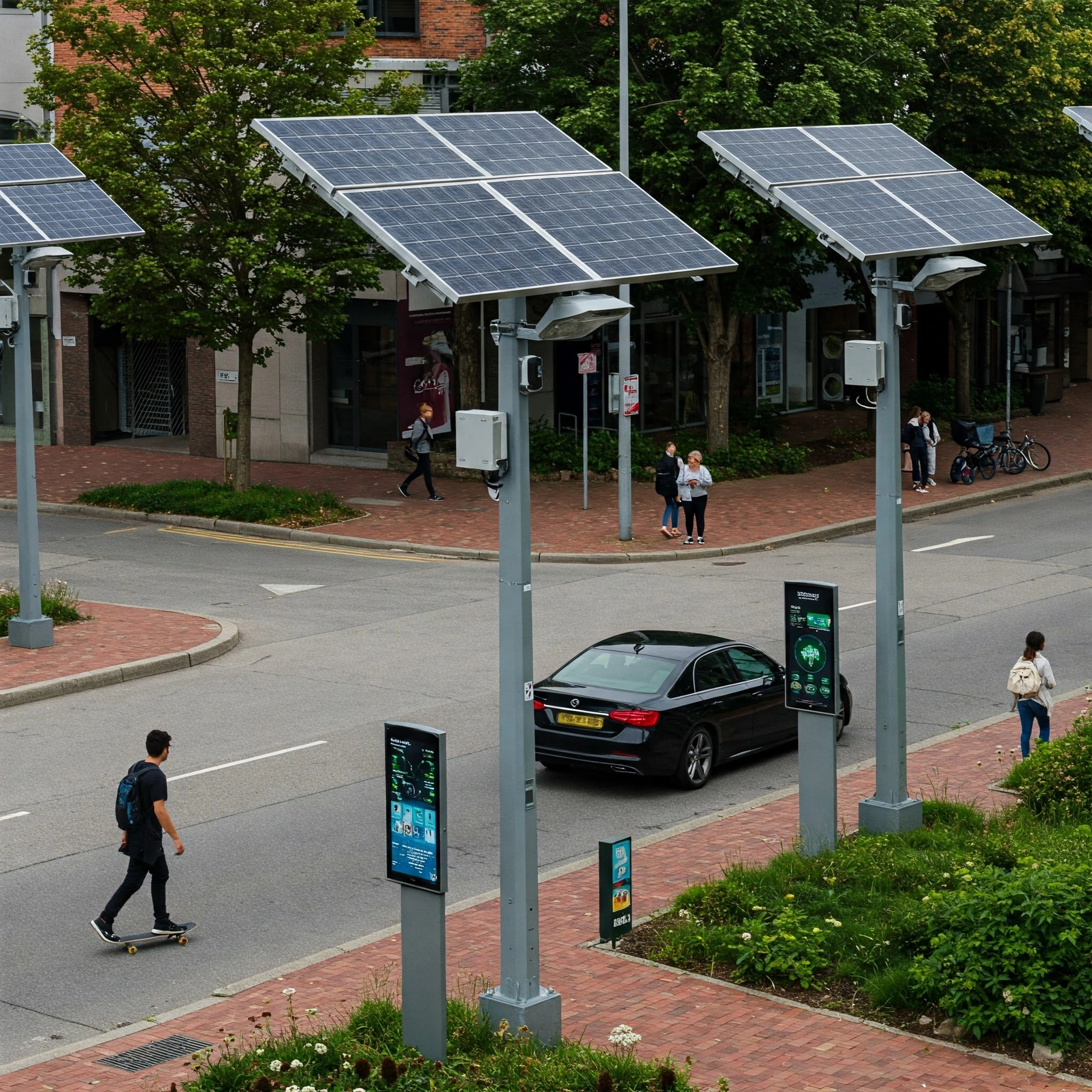
Billboards often stand where the grid does not: along remote highways, on farmland leased for advertising, in newly developed zones where trenching cable is expensive. A solar flood light moves the energy source onto the pole, removing trenching and monthly electricity costs entirely.
The trade-offs are the same as any solar lighting project: the panel and battery must be sized for nightly runtime, cloudy-season recovery and local sun levels. Our solar vs wired flood light comparison walks through the total cost of ownership method so you can check whether the off-grid route pays back on your site. For billboards that must stay lit every night of the year, ask the supplier to confirm the energy balance in writing rather than accepting a generic wattage recommendation.
Specification Checklist for Your RFQ
Use this list when requesting quotes so every supplier answers on the same basis:
| Item | What to ask for |
| Panel and geometry | Panel dimensions, mounting position, fixture setback or bracket length |
| Lighting target | Average illuminance on the panel and uniformity approach, with a calculation or simulation |
| Fixture data | Lumens, beam angle, IP rating, driver type and expected LED lifetime (L70) |
| Mounting | Bracket material and finish, wind load basis, fixing method |
| Control | Dusk-to-dawn photocell, timer or scheduled dimming for solar models |
| Commercial | MOQ, sample policy, lead time, warranty terms in writing |
How Qichenshop Supports Billboard Flood Light Projects
Qichenshop supplies outdoor LED flood lights for billboard, signage and facade projects on a quotation basis. Flood light models are quoted per project, so the fastest path is to send us your panel size, mounting sketch and nightly lighting target, and we will come back with a fixture recommendation, current model list and datasheets in writing.
Standard commercial terms: MOQ from 50 units, T/T 30% + 70% payment, typical production lead time 15 days (15 to 25 days for customized configurations), and quotations valid for 30 days. Sample policy: OEM samples at USD 50 and ODM samples at USD 300, freight collect, refundable against a first order of USD 1,000 or more. Outdoor fixtures carry an IP65 sealing specification and a 5-Year Limited Warranty. Solar models ship with dusk-to-dawn photocell and timer control as standard; integration with smart city or remote monitoring platforms is available as an optional, customizable feature. If you want to sanity-check supplier quotes before committing, our price comparison framework applies to flood light quotations too.
Ready to light your next billboard project? Request a billboard flood light quote with your panel dimensions and mounting details, or ask for the current model list and datasheets, and our team will reply with a written recommendation.