


On outdoor lighting projects in the Philippines and Nigeria, the failures that end up on a punch list six months after commissioning are rarely electronic. They are water: condensation fogging the lens from the inside, a corroded cable gland, a driver compartment that turned into a small aquarium during the first heavy monsoon downpour. The IP rating printed on the datasheet is supposed to prevent exactly this, yet it is also the most commonly misunderstood two-character specification in the industry.
This guide explains what the two digits of an IP code actually verify, compares IP44 with IP65 side by side, maps each level to real installation positions, and lists what to check beyond the number before you place an order. It applies to solar street lights, LED flood lights and outdoor wall lights alike, because the ingress physics are identical across all three product lines.
What the Two Digits in an IP Code Actually Mean
IP stands for Ingress Protection, defined by the international standard IEC 60529. The code always has two digits. The first digit describes protection against solid objects and dust, from 0 (no protection) up to 6 (dust tight, meaning no ingress of dust at all). The second digit describes protection against water, from 0 (no protection) up through increasing levels of spray, jet and splash resistance. For outdoor lighting the two values that matter on site are 5 or 6 on the first digit and 5 on the second: dust-protected or dust-tight housings that also survive low-pressure water jets from any direction.
| Second digit | Water protection verified by IEC 60529 | What it survives outdoors |
|---|---|---|
| 0 | No protection | Nothing. Not an outdoor rating |
| 1 | Vertical dripping water | Sheltered interiors only |
| 2 | Dripping water at a slight tilt | Under a deep canopy |
| 3 | Spraying water, up to 60 degrees from vertical | Covered porches, rain with wind |
| 4 | Splashing water from any direction | Open eaves, exposed walls in light rain |
| 5 | Low-pressure water jets from any direction | Pole tops, open walls, driving monsoon rain |
The scale continues to higher second digits for equipment designed to be submerged, but pole-top and wall-mounted lighting is never installed underwater, and a bigger number does not make a fixture better built. What separates a real IP65 product from a paper IP65 product is the sealing system behind the rating: the gasket material, the compression of that gasket, the cable glands and the breathability of the housing. That is where your inspection time belongs.
IP44 vs IP65: What Each Rating Actually Guarantees
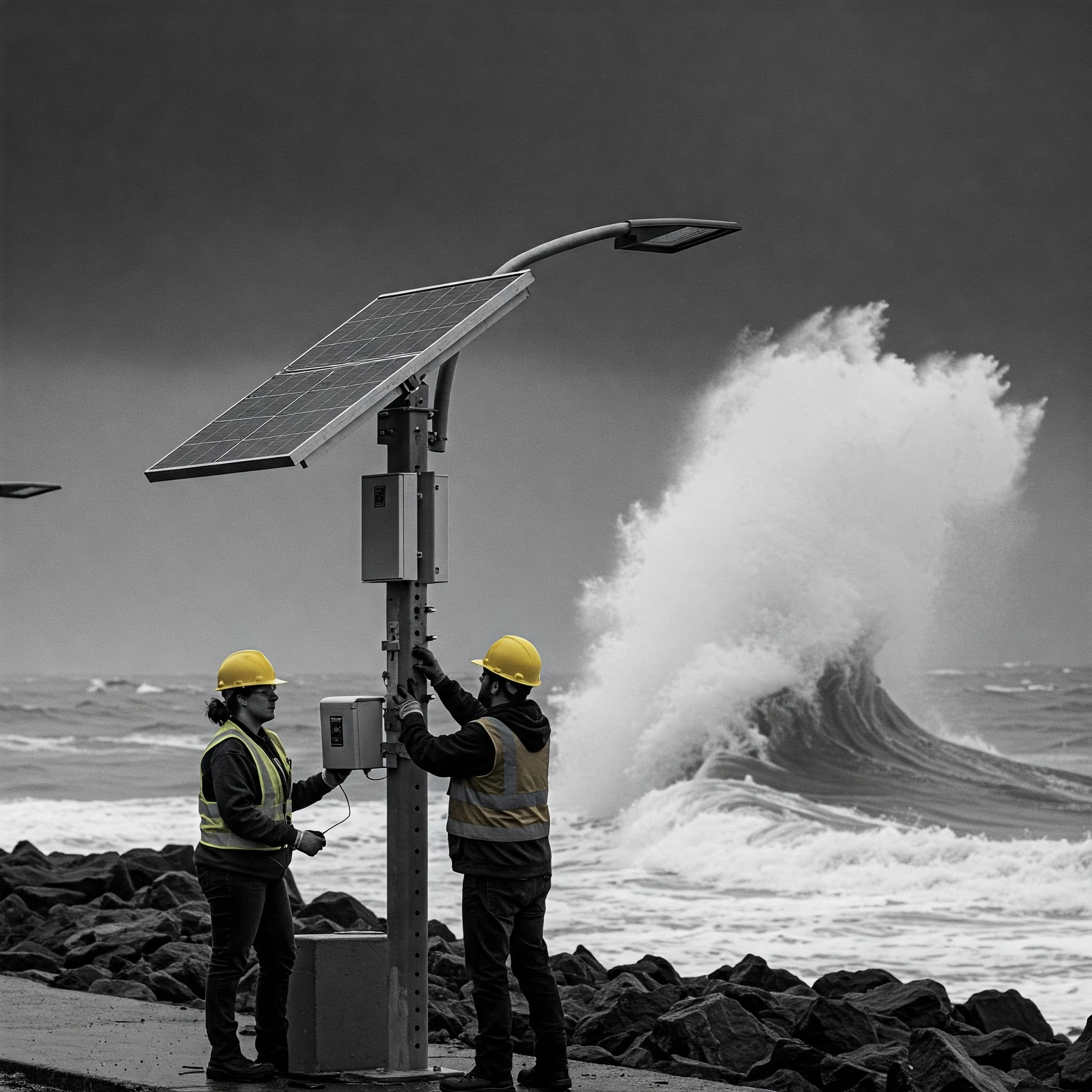
IP44 and IP65 sit on opposite sides of the line that matters for outdoor reliability. IP44 protects against splashing water; IP65 protects against water jets. In plain terms: IP44 survives rain falling on it, IP65 survives rain being driven at it under pressure, which is what happens to anything mounted on a pole at six to ten meters, or on a wall facing an open compound during a typhoon.
| Aspect | IP44 | IP65 |
|---|---|---|
| First digit (solids) | 4: protected against objects over 1 mm | 6: dust tight, no ingress at all |
| Second digit (water) | 4: splashing water from any direction | 5: low-pressure jets from any direction |
| Dust and fine particles | Limited; fine dust and sand can enter | None can enter; sealed housing |
| Sealing system | Basic gaskets or drip shields | Continuous gasket, sealed lens, gland-sealed cable entry |
| Survives driving rain | No | Yes |
| Survives harmattan or coastal dust | No | Yes |
| Suitable for pole-top street lights | Not recommended | Working minimum |
| Typical position | Covered eaves, indoor-adjacent walls | Any fully exposed outdoor position |
Where IP44 Is Still an Acceptable Choice
IP44 is not a bad rating; it is a correctly scoped one. It suits fixtures mounted under a roof overhang or a deep canopy, on covered walkways, in stairwells and courtyards with an overhead shelter, or on interior-adjacent walls where driving rain never reaches. If the fixture will never see pressurized or wind-driven water and the air is not dusty, paying for IP65 sealing buys little.
The mistake to avoid is using IP44 logic to buy lighting that will be mounted in the open. A wall light under a protected eave and the same model on a compound perimeter wall without any cover live in two different environments, even though the mounting height looks identical on a drawing.
Where IP65 Is the Working Minimum
- Pole-top solar street lights: at 6 to 10 m the fixture catches the full force of wind-driven rain, and maintenance access means a failed seal is expensive to service, not just annoying.
- Facade and ground-mounted flood lights: aimed upward or outward, they collect rain on the lens and dust on every surface; see the flood light selection guide for positioning details.
- Open compound perimeters: wall lights with no overhead cover, exposed to the same jet-level wetting as the pole tops.
- Coastal and high-dust regions: salt haze and harmattan sand both attack anything less than a dust-tight, jet-proof enclosure.
- Any fixture inside a sealed housing with LiFePO4 electronics: moisture plus lithium battery management electronics is the combination that turns a small leak into a dead unit.
Matching the Rating to the Climate: Philippines and Nigeria
In the Philippines, the design case is months of sustained monsoon rain and typhoon events where rain arrives horizontally at speed. That is textbook jet-exposure: an IP44 housing that passes a light-rain afternoon can ingest water during one typhoon night. In Nigeria, the dry-season case dominates: harmattan carries fine dust for weeks, and dust is what IP44 was never tested against, because its first digit only stops objects over 1 mm. Dust buildup inside a lens and on a PCB also traps moisture once the rains return.
Both climates converge on the same conclusion for exposed positions: specify dust-tight and jet-resistant, which is IP65, and treat any lower rating on a fully exposed fixture as a selection error rather than a cost saving.
Quick Selection Table by Installation Position
| Position | Exposure | Recommended minimum | Note |
|---|---|---|---|
| Solar street light, pole top | Full sky, wind-driven rain | IP65 | All Qichen solar street light models are IP65 |
| Flood light on open facade or ground | Full sky or upward wash | IP65 | Aim and lux planning: see the lux calculation guide |
| Wall light under eave or canopy | Sheltered from above | IP44 | Check splash reach from open sides |
| Wall light on open perimeter wall | Exposed, no cover | IP65 | Treat like a pole-top fixture |
| Covered parking, warehouse interior wall | Sheltered | IP44 | Dust still argues for IP54 or better |
| Coastal installations of any type | Salt haze plus rain | IP65 | Ask for gasket and gland details as well |
What to Check Beyond the IP Number on a Datasheet
An IP65 claim is a test result for a design, and two products with the same printed code can differ enormously in how long the seal lasts. Before you award an order, ask the supplier these five questions:
- How was the rating verified? A type-test report on the housing design is worth far more than a number typed onto a datasheet.
- What is the gasket material and how is it compressed? Silicone or EPDM with consistent compression survives thermal cycling; foam tape does not.
- How do cables enter the housing? The cable gland, not the lens, is where most real-world ingress starts on street lights.
- Does the housing breathe or fully seal? A fully sealed housing needs correct manufacturing; condensation claims on a sealed unit point to a process problem.
- Does the warranty cover water ingress? Read what the warranty actually includes before you need it; our position on what five years should cover is set out in the warranty explainer.
IP65 Across the Qichen Range
Every solar street light we manufacture, from the all-in-one range such as the A21 all-in-one solar street light to the modular A01 split solar street light, is sealed to IP65 with a dust-tight housing and gland-sealed cable entry, and carries a 5-year limited warranty. Flood light and wall light projects are quoted to the same sealing standard for exposed positions; the full catalogue is in the shop. The same logic extends to shipping and battery handling, which we cover separately for importers.
If you are comparing quotations and one fixture is noticeably cheaper at IP44 where your site needs IP65, that saving is a deferred maintenance invoice. Send us your installation positions and site conditions, and we will confirm the correct sealing level and model for each position rather than quoting one number for the whole project.
Request the IP65 sealing details and datasheets for the models you are comparing: visit our contact page or email info@qichenshop.com, and include the mounting heights and site exposure so the reply comes back with the right specification, not a generic catalogue.