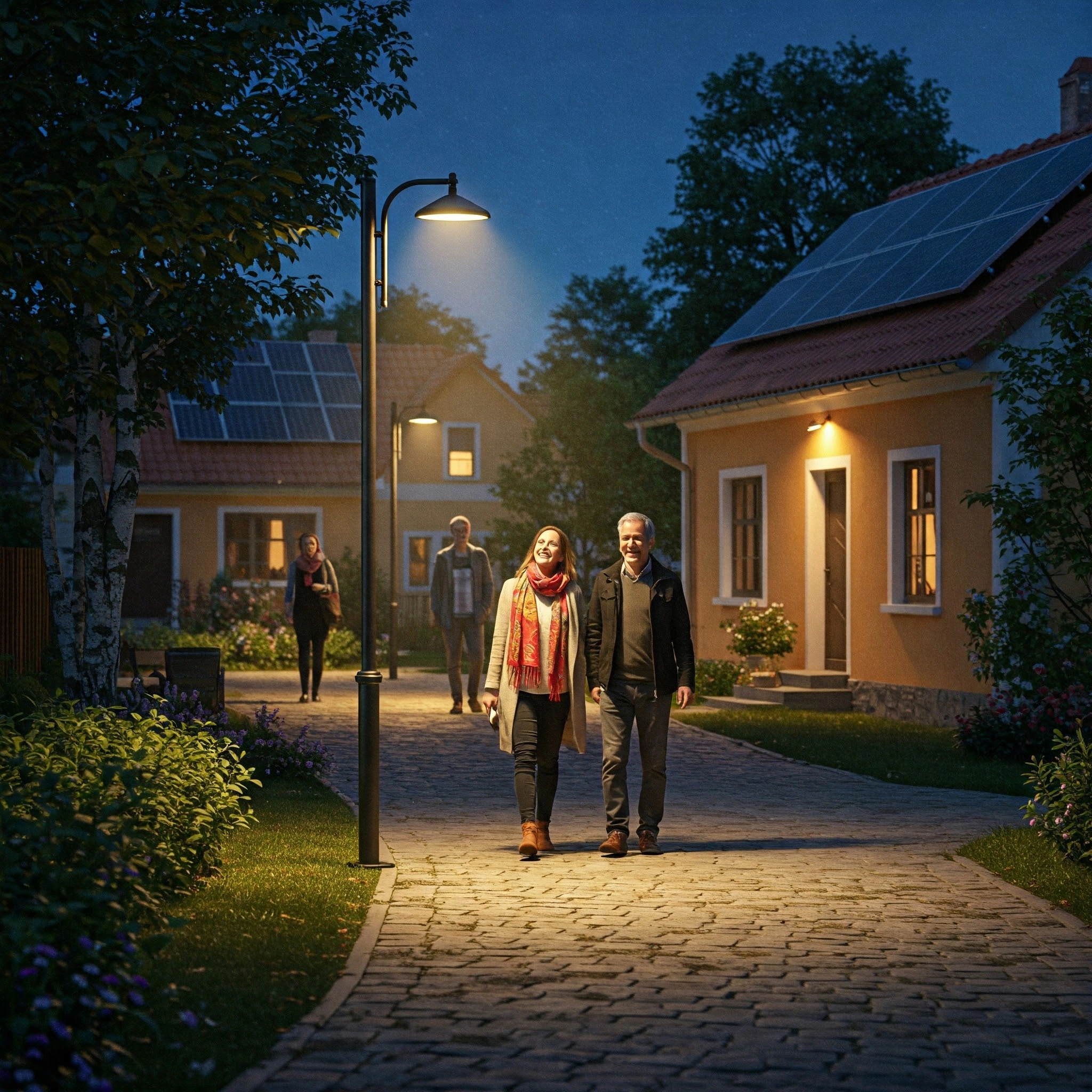



On villa, hotel and compound projects, most outdoor wall light complaints are not electrical faults. They are selection errors: a fixture bought by wattage that throws a hard pool of light onto a wall it was never meant to graze, an entry light mounted too low so it glares into the face of every guest, a powder-coated housing that chalks and blisters within two rainy seasons, or a beam aimed straight at the neighbour’s bedroom window and the boundary dispute that follows.
The selection logic below is written the way a lighting designer or a project engineer would apply it — mounting height first, beam distribution second, materials third, quantity last. Use it to write a fixture schedule that suppliers can actually respond to, and to check the quotations that come back.
Start With Mounting Height, Not Wattage
A wall light is a directional fixture mounted close to a vertical surface. Its useful result is decided by three numbers: the height of the lens above the surface being lit, the beam angle, and the delivered lumens at that angle. Wattage on its own tells you almost nothing, because the same 12 W can be shaped into a narrow 24° pencil of light or a 120° wash.
The quick geometric check: a beam of angle θ at throw distance d covers roughly 2 × d × tan(θ/2) on the surface. A 45° downlight mounted 2.2 m above the paving covers about 1.8 m across; the same fixture at 3.5 m covers nearly 2.9 m and drops in illuminance by roughly the square of the distance. That is why moving a fixture 1.3 m higher usually means a wider beam and more delivered lumens, not the same fixture on a taller bracket.
| Position | Typical mounting height | Beam angle | Delivered lumens (spec range) | Role |
|---|---|---|---|---|
| Step, deck and planter | 0.4 – 0.9 m | 60–90° | 150 – 400 lm | Low-level safety, planted edge accent |
| Entry door, villa porch | 1.8 – 2.4 m | 45–60°, asymmetric down | 400 – 800 lm | Door identification, face and keyhole illumination |
| Villa facade panel | 2.4 – 3.5 m | 24–45° up and down | 600 – 1,200 lm | Vertical rhythm, texture grazing |
| Hotel walkway, corridor | 2.4 – 3.2 m | 45–60° | 800 – 1,500 lm | Even passage light, CCTV support |
| Compound wall top | 2.0 – 3.0 m (wall height) | 60–120° down | 500 – 1,000 lm | Perimeter spill, boundary definition |
| Car park pier, service wall | 2.5 – 4.0 m | 30–60° | 1,000 – 2,000 lm | Vehicle movement, wayfinding |
Treat the lumen column as a specification starting point to be confirmed by calculation, not a catalogue claim. Two fixtures quoting the same lumens can land very differently on the wall once optics, diffuser losses and aiming are taken into account — which is why the photometric file matters more than the number on the box.
Four Distinct Roles a Wall Light Plays on One Site
A compound is rarely lit by one fixture type. Villa and hotel projects normally need four different wall-mounted roles, and mixing them up is the most common reason a facade looks cluttered while the walkway is still dark.
- Entry and doorway. Needs a defined pool of light at the threshold with the lens set back so it does not glare at eye level. A shielded downlight or a fixture with a honeycomb louvre is the safe choice.
- Facade grazing. Up-and-down fixtures placed on structural piers rather than between windows, spaced to create an even rhythm. The beam should skim the surface at a shallow angle; a beam pointed straight out simply becomes glare.
- Compound wall. Fixtures mounted on the wall cap or the outer face, aimed down and slightly inward, so the light lands on your paving instead of over the boundary.
- Low-level accents. Step lights and planter lights at 0.4–0.9 m for safety on level changes; these are the fixtures that get kicked, so IK rating and recessed lenses matter more than output.
Up, Down, or Both: Getting the Beam Right
Up-and-down wall lights are the standard for hotel facades because the two cones create a vertical rhythm that reads well from a distance. The trade-off is uplight: every lumen sent above the horizontal contributes to skyglow and, near a boundary, to light trespass. On residential compounds the practical rule is to keep the upward component modest and to aim the cones at solid wall rather than at open sky.
Three details separate a clean installation from a glare complaint:
- The light source sits recessed behind the trim, not flush with it, so the LED is not visible from standing eye height.
- The optic is asymmetric or shielded where the fixture faces a walkway, so the beam is pushed down and along the wall rather than outwards.
- The fixture is specified with a stated cut-off or glare control (louvre, honeycomb, frosted lens, deep baffle) rather than left to the installer’s aiming judgement.
For boundary walls, the direction of the beam is also a legal question, not only an aesthetic one. Aim the light inside the property line, keep the fixture head below the top of the wall where local rules require it, and check the light pollution clause in the project’s planning approval before the fixture schedule is frozen.
Materials and Finishes That Survive Coastal Air
In the Philippines, Nigeria and similar humid coastal markets the housing and the coating fail long before the LED does. Salt-laden air, monsoon rain and 30–35 °C wall temperatures attack every weak point: cut edges, fastener threads, gasket seats and cable entries.
| Housing | Corrosion behaviour | Best use | Watch out for |
|---|---|---|---|
| Die-cast aluminium, powder coated | Good when pretreatment and coating thickness are controlled | Facade, entry, wall-top fixtures | Uncoated cut edges and poor chromate-free pretreatment |
| Stainless steel 304 | Fair inland, pitting possible at the coast | Feature fixtures, handrails | Tea staining and pitting within 1–2 km of the sea |
| Stainless steel 316 / 316L | Best metallic option in salt air | Coastal boundary walls | Cost, and welded joints left unpassivated |
| Engineering polycarbonate | No corrosion, UV yellowing risk | Step and planter lights | Cheap grades that embrittle in sun |
| ABS or mixed plastic | No corrosion, low impact strength | Decorative indoor-adjacent use | Distortion and colour shift on hot walls |
For powder-coated aluminium, write the coating requirement into the purchase order instead of accepting “electrostatic powder coated” as a description: pretreatment type, nominal coating thickness (60–80 µm is a common specification band), and a neutral salt spray test to ISO 9227 at the hours your project requires. Ask for the test report per batch, not per product family.
Two small parts decide whether the fixture stays dry: the gasket and the fastener. Silicone gaskets hold compression set better than EPDM on hot walls, and 316 stainless screws prevent the rust streaks that ruin a freshly painted facade. Where the housing is fully sealed, a pressure-equalisation vent avoids the pumping effect that pulls humid air past the gasket every time the fixture heats and cools.
What IP65 Actually Buys You, and What It Does Not
IP65 means dust-tight and protected against water jets. It does not mean the fixture can be submerged, and it says nothing about condensation. On a wall light the ingress path is rarely the front lens; it is the cable gland, the mounting screw holes and the gasket line, particularly when the gland faces upward or the cable loop collects water.
Specify IP65 as the minimum for any exposed outdoor position, then close the gaps the rating does not cover: gland orientation downward, cable loop below the entry, sealed screw caps, and a driver compartment that is either fully potted or vented on purpose. Thermal design is the other half. Wall lights are small enclosures with little surface area, and a driver pushed to its limit inside a sealed housing on a 40 °C wall will lose years of life quietly. Ask for the driver’s rated ambient temperature and the LED’s lumen maintenance data, and derate if the fixture is mounted on a dark surface with no airflow.
Voltage, Surge and Controls
Most projects in the region run 220–240 V at 50 Hz, with voltage sag at the end of long compound feeds and lightning-induced surges during the rainy season. Both are cheap to design for and expensive to discover later: specify a driver with a wide input range and add surge protection at the circuit level, not only at the fixture.
Control strategy should match how the site is actually operated. Photocells suit perimeter and facade lighting that runs dusk to dawn; PIR or microwave sensors suit corridors and service areas used intermittently; 0–10 V or DALI dimming suits hotel projects with a central management system and a curfew scene. Put facade lighting and security lighting on separate circuits, so the decorative layer can be switched off after midnight while the perimeter stays lit.
When Solar Wall Lights Make Sense
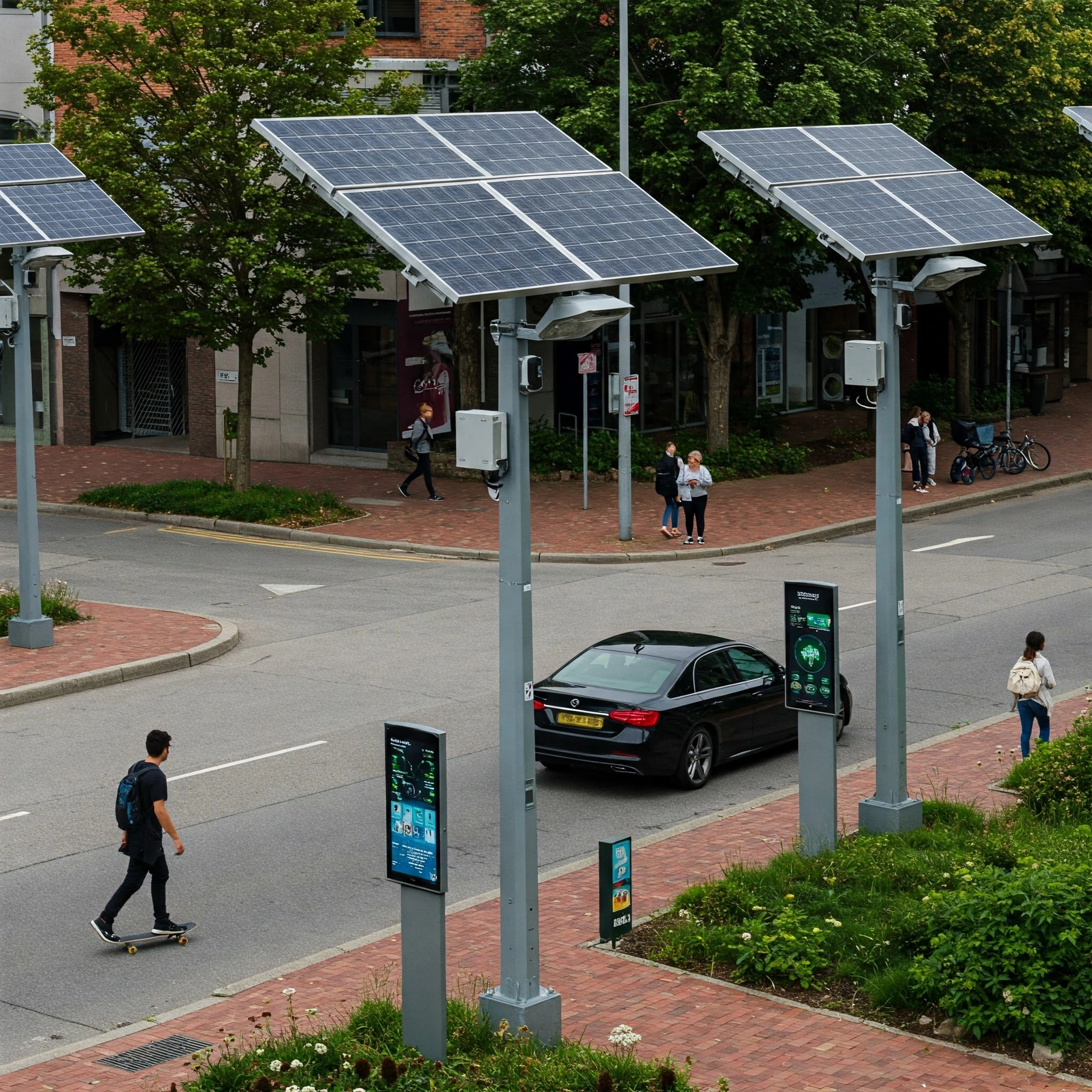
On a long boundary wall with no power at the far end, trenching and cabling can cost more than the fixtures. Solar wall lights remove the trench, but they add two constraints that are usually underestimated: panel area and battery heat. A wall-mounted solar head has a small collector, so its useful output is a fraction of what a mains fixture of the same body size delivers, and a battery packed against a sun-heated wall runs hotter than one on a pole.
- Use solar wall lights for gate piers, remote wall sections and service yards — not for facade grazing, which needs sustained output for hours.
- Choose LiFePO4 cells over lead-acid or gel for high ambient temperatures; the chemistry is more tolerant of heat and deep cycling.
- Mount the head on a bracket with an air gap behind it, and keep the battery compartment out of direct afternoon sun on west-facing walls.
- Check autonomy honestly: a fixture sized for three cloudy days needs a larger panel and battery than the one sized for one.
Where the perimeter also carries vehicle traffic, the wall lighting is only half the design. Compound roads and parking aisles are normally better served by pole-mounted solar street lights — for example the split-type A01 split solar street light or the all-in-one A21 all-in-one solar street light, both built around LiFePO4 battery packs — with wall lights doing the threshold and facade work at pedestrian level.
A Transparent Way to Estimate Fixture Quantity
Before any photometric study, you can sanity-check a layout with two rules of thumb. For passage and perimeter lighting, spacing is usually 2.5–4 times the mounting height. For facade rhythm, spacing follows the structural bays, typically 1.5–2.5 times the mounting height, so the cones line up with piers rather than windows.
Worked example: a 120 m compound wall, fixtures at 2.8 m on the wall cap, spacing 8 m (roughly 2.9 × mounting height). That is 120 ÷ 8 = 15 spacings, so 16 fixtures on a straight run, plus doubled fixtures at the two gate piers and one at each corner return. Round up to 20 fixtures and you have a budget quantity that will survive the first layout review.
Second example: an 18 m hotel entrance facade with piers every 4.5 m. At a spacing equal to the bay, that is 5 up-and-down fixtures, with the entry door treated separately by two shielded downlights. Note that these counts are planning estimates only; final numbers come from a calculated layout, and the method for that is set out in our guide to lux calculation with worked examples, which applies the same area-and-target-illuminance logic.
Tender Specification Checklist
Most wall light disputes trace back to a specification that described the look of the fixture but not its performance. The table below is the minimum set of lines that makes quotations comparable.
| Specification line | What to write | Why it matters |
|---|---|---|
| Housing and finish | Material, pretreatment, coating thickness, salt spray hours to ISO 9227 | Coastal projects fail on coating, not on LEDs |
| Ingress and impact | IP65 minimum; IK rating for exposed and low-level positions | Defines what the warranty can be claimed against |
| Light output | Delivered lumens, beam angle, CCT and CRI at stated drive current | Chip lumens and delivered lumens differ substantially |
| Photometric file | IES or LDT file per model | No file, no verifiable layout |
| Driver | Rated ambient temperature, input voltage range, replaceable or potted | Driver life sets fixture life in hot climates |
| Surge protection | Class and location (fixture or circuit level) | Lightning season is the main failure window |
| Warranty | Component-level terms, claim steps, spare parts supply | “5 years” alone is not a warranty term |
| Approval and spares | Sample approval before bulk; spare ratio per 100 units | Avoids a mismatch discovered on site |
If the warranty wording in a quotation is a single sentence, treat it as unfinished. Our own component-level breakdown is published in this guide to what a five-year warranty should cover, and the same questions apply to wall fixtures: which components, which standard, who pays freight, and how a claim is proven.
Six Selection Mistakes Worth Avoiding
- Buying by wattage instead of by delivered lumens at the mounting height actually available.
- Using one fixture type for entry, facade and wall cap, then compensating with extra fittings.
- Specifying a decorative housing with an exposed lamp, and discovering the glare problem only after the first guest complaint.
- Accepting “powder coated” without pretreatment, thickness or salt spray data on a coastal site.
- Mounting the cable gland upward, which turns a sealed fixture into a water trap.
- Leaving the layout to the installer’s eye instead of issuing a spacing drawing with the fixture schedule.
Working With Qichen on a Wall Light Package
Qichen Lighting has been manufacturing outdoor lighting since 2010, first registered as Zhongshan Qichen in 2013 and now operating from Jiangmen, Guangdong. Our published catalogue covers 28 solar street light models for compound roads, parking areas and site access; wall-mounted outdoor fixtures for villa, hotel and perimeter work are quoted per project against your fixture schedule, so ask for the current model list and datasheet before the specification is frozen.
Standard commercial terms on quoted projects: MOQ from 50 units, T/T 30% deposit with 70% against shipping documents, typical production lead time 15 days after drawing and sample approval, and the 5-Year Limited Warranty stated component by component in the quotation. Outdoor fixtures are specified at IP65 as standard for exposed positions.
To get a comparable quotation, send us four things: wall elevations with mounting heights, the target CCT and beam direction per position, the site’s distance from the sea, and your required salt spray and warranty terms. We will come back with a fixture schedule mapped position by position rather than a single price per piece. Contact Qichenshop with your drawings, or browse the full product catalogue to see the current range and datasheets.