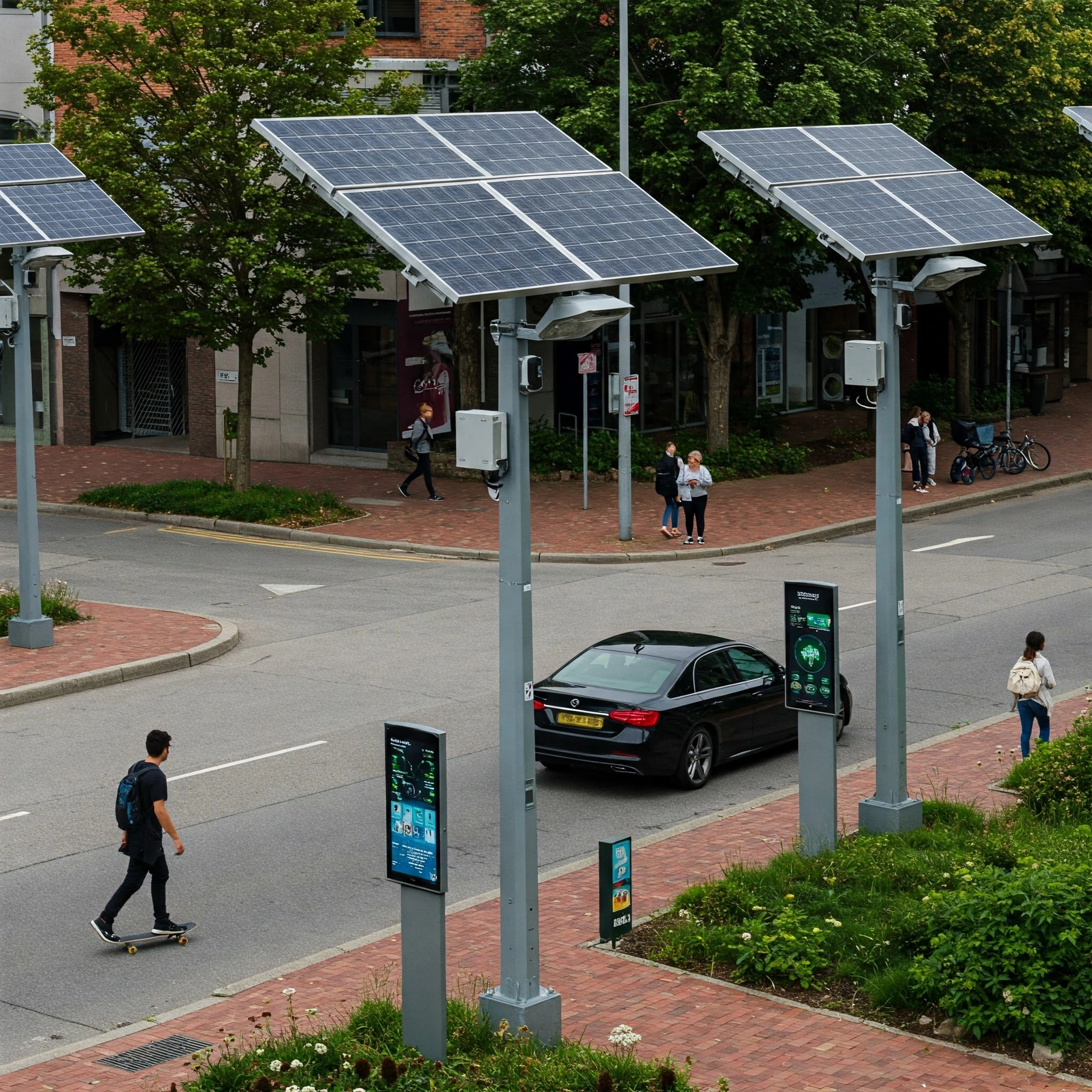



Parking lots are one of the most practical places to deploy solar street lighting: wide open sky, zero trenching across existing asphalt, and lighting that stays on even when the grid does not. This guide walks procurement teams, contractors and facility managers through the three decisions that decide whether a solar parking lot project performs or disappoints: layout, fixture choice, and a realistic cost framework.
Why Open-Air Parking Lots Suit Solar Street Lights
Surface parking lots combine three conditions that favor solar: they are usually free of tall shading, they sit far from existing electrical infrastructure more often than buildings do, and they are often lit for long hours every night, which makes grid extension and monthly energy bills a recurring cost.
- No trenching or ducting across asphalt – the lighting poles are self-contained, so retrofit projects do not require repaving.
- Phased expansion is simple – add poles section by section as a site is developed, instead of sizing a transformer on day one.
- Blackout resilience – lots for hospitals, logistics compounds and government facilities keep operating through power cuts.
- Leased or temporary sites – lighting assets move with the tenant rather than being written off with the pavement.
The approach changes when lots sit under canopies, in multi-storey structures, or surrounded by tall trees. A photovoltaic panel needs direct sun; a shaded parking structure calls for a grid-tied solution instead. Check shading before anything else.
Start With Lux Targets, Not Wattage
Buying by wattage is the fastest way to overspend or under-light a lot. Start from the illuminance level the task actually requires, then work backwards to lumens, pole height and spacing. The table below reflects typical design targets used in outdoor lighting practice; always confirm the level required by your local code or client specification before tendering.
| Area within the lot | Typical design target (average lux) | Notes |
|---|---|---|
| Entry and exit lanes | 20-30 lux | Highest activity, pedestrian and vehicle conflict points |
| Main drive aisles | 10-15 lux | Continuous coverage along the traffic route |
| Parking bays | 5-10 lux | Long-term parking needs less light than circulation lanes |
| Perimeter and low-activity zones | 3-5 lux | Deterrence lighting; motion profiles can raise it on demand |
Two rules keep designs honest: specify average maintained lux at ground level (not fixture wattage or chip lumens), and ask suppliers to state real delivered lumens backed by an IES file or a lighting simulation for your layout.
Layout Method: Pole Position, Spacing and Light Distribution
A workable starting method for a rectangular lot: place poles along the drive aisles rather than between every bay, aim for a mounting height of 6-8 m for typical commercial lots, and keep the spacing between poles at roughly 3 to 4 times the mounting height for uniform coverage. Perimeter rows can use a wider spacing with the fixtures tilted toward the lot interior.
The spacing depends on the delivered lumens and the light distribution of the fixture, so treat any fixed number as a starting point and verify it with a calculation. Our solar street light spacing calculator turns pole height, target lux and fixture output into a first-pass pole count, and the companion article on layout and spacing for roads and lots explains the formula step by step.
For most lots the formula is straightforward: number of poles = (target lux x area) / (fixture lumens x utilization factor x maintenance factor). A utilization factor of 0.3-0.4 is a realistic planning assumption for pole-mounted street light optics; insist on a simulation for the final design.
Fixture Choice: All-in-One vs Split on Parking Duty
Both architectures work in parking lots; the right choice follows from pole height, nightly burn hours and who maintains the site.
| Criterion | All-in-one solar street light | Split solar street light |
|---|---|---|
| Typical mounting height | 4-7 m, smaller bays and perimeter rows | 6-10 m+, main aisles and large lots |
| Panel and battery | Integrated, compact, fast to install | Separate and larger – higher output per pole |
| Maintenance | Unit swap – simplest for remote sites | Component-level repair on site |
| Best fit | Perimeter rows, small lots, phased rollouts | Main aisles, high-mast lots, high-burn-hour sites |
| Installation | One lift, one crew, under an hour per pole | More rigging, but easier future upgrades |
For main aisles where a 7-9 m pole and long nightly run time are planned, a split model such as the all-in-one solar street light A21 family carries the larger panel and battery configuration that long-autonomy operation requires. Battery chemistry matters in hot climates: LiFePO4 cells tolerate high ambient temperatures far better than sealed lead-acid and deliver more usable cycles over a 5-year service window.
Cost Framework: What Actually Drives the Total
Quoted prices per fixture tell only a fraction of the story. Compare offers on the full installed and lifetime picture, especially for lots where trenching is the hidden budget killer. The framework below contains no price figures by design – request itemized quotes against it and the differences between suppliers become visible on one page.
| Cost element | Solar street light | Grid-tied street light |
|---|---|---|
| Cabling and trenching | None – no grid connection needed | Trenching, ducting, cabling across pavement |
| Energy over lifetime | Zero – sunlight is the fuel | Monthly bill, exposed to tariff increases |
| Installation | Pole foundation and fixture mounting only | Foundation plus electrical crew and utility liaison |
| Battery replacement | Planned cycle (typically within the warranty window) | Not applicable |
| Outages | Keeps lighting through grid failures | Dark until power returns |
| Relocation | Poles can be moved with the site | Infrastructure is fixed in place |
When you review quotes, align the comparison line by line: delivered lumens at ground level, battery capacity in watt-hours and chemistry, panel wattage, autonomy days at the specified lighting profile, IP65 ingress protection, and the warranty split between fixture, battery and controller. A quote that states none of these is a quote you cannot compare.
Five Layout Mistakes That Waste Money on Parking Lots
- Sizing panels for full sun year-round – coastal and rainy-season sites need panel-to-battery headroom or the lights dim mid-night within months.
- Spacing poles by guesswork at low mounting heights – a 6 m pole cannot carry the spacing a 9 m pole can; verify with the calculator before ordering.
- Ignoring canopy and tree shading – a panel in shadow for three afternoon hours loses most of its charging window; relocate poles or switch to grid-tied there.
- Skipping motion profiles – lots that empty at night pay for full brightness until dawn; a dusk-to-dawn profile with motion-based boost cuts battery size for the same perceived security.
- Buying on chip lumens – marketing lumen figures describe the LED chip, not the light reaching the asphalt; compare delivered lux from a simulation instead.
A Worked Sizing Example
Take a 60 m x 30 m open-air lot (1,800 m²) with a 10 lux average target for the main area. Required raw lumens = 10 x 1,800 = 18,000 lm. Applying a utilization factor of 0.35 and a maintenance factor of 0.85 gives an installed requirement of roughly 18,000 / (0.35 x 0.85) = 60,600 lm. With a fixture class delivering 8,000 lm (check the datasheet of the exact model for its real output), the first-pass count is about 8 poles along the two drive aisles – then adjust for entry lanes, perimeter rows and the motion profile.
This is deliberately a first-pass method: it tells you the scale of the order and the pole budget, not the final drawing. Send your lot dimensions and target hours to the supplier and ask for a lighting simulation before signing.
If you are planning a parking lot retrofit or a new development, send us the lot dimensions, mounting height preference and nightly operating hours – our engineers will return a layout proposal with fixture selection and an itemized quotation. Qichenshop has manufactured solar lighting since 2010 (first registered as Zhongshan Qichen in 2013), ships from a 28-model catalog with MOQ from 50 units, and backs fixtures with a 5-Year Limited Warranty. Request a parking lot lighting proposal or browse the full range in our solar street light catalog – for adjacent areas such as loading zones and signage, see our LED flood light buying guide.