



If you are sourcing solar street lights for a distributor inventory, a government road tender or an EPC installation, one question comes up before everything else: should you buy all-in-one (integrated) solar street lights or split (separated) solar street lights? The right answer depends on your project’s power requirements, installation conditions, maintenance strategy and total budget – not on which type looks more modern.
In this guide, we compare both systems across the factors that actually decide project outcomes:
✔ Structure and components
✔ Installation and labor
✔ Battery performance in hot climates
✔ Maintenance and spare parts
✔ Total project cost
What Is an All-in-One Solar Street Light?
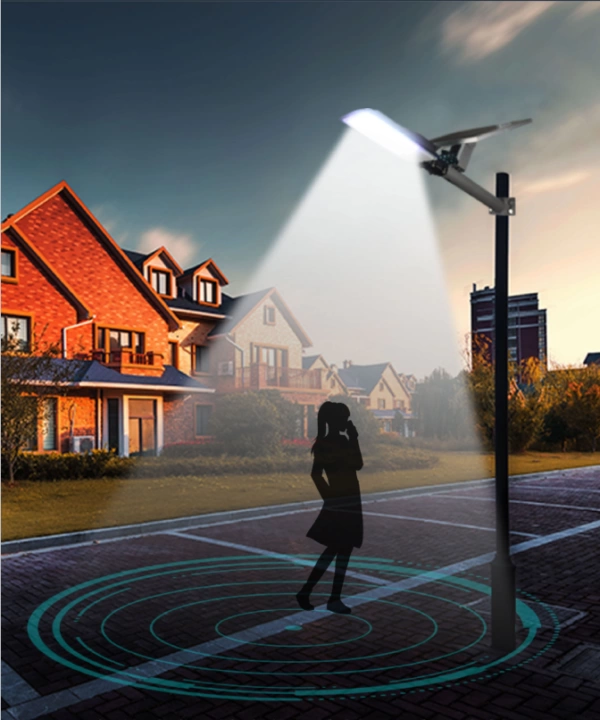
An all-in-one solar street light integrates the solar panel, LED luminaire, lithium battery and charge controller into a single compact fixture. There is no external cabling between components: you mount the unit on the pole, and the system is complete.
This design is common in the 20W-120W range and is widely used for residential streets, community roads, parking areas, campus walkways, parks and perimeter lighting. Because the panel and battery are sealed inside the fixture, there are no exposed cables – which also removes the most common point of failure and the main target for cable theft.
What Is a Split Solar Street Light?
A split solar street light separates the system into individual components: a standalone solar panel mounted on top or on an extended arm, a battery box (often mounted lower on the pole for thermal and security reasons), a controller and the LED luminaire. The components are connected through cables.
Because each component is sized independently, split systems can carry larger panels and larger battery banks than an integrated housing can physically fit. That makes them the standard choice for highways, main roads, large industrial areas and projects that must run at high power for long hours or through several cloudy days.
All-in-One vs Split Solar Street Lights: Side-by-Side Comparison
| Factor | All-in-One | Split |
|---|---|---|
| Structure | Panel, battery, controller and LED in one fixture | Separate panel, battery box, controller and luminaire |
| Typical power range | About 20W-120W | About 60W and above (scales further) |
| Installation | Fast; no wiring between components | Slower; requires wiring and component mounting |
| Wiring failure and cable theft risk | Minimal (no external cables) | Present; cables must be protected |
| Battery capacity | Limited by fixture size | Can be sized much larger |
| Maintenance | Simple; fewer external parts | Individual components can be replaced separately |
| Best applications | Residential roads, parking lots, parks, walkways, compounds | Highways, main roads, industrial areas, large infrastructure |
Installation and Labor: Where All-in-One Wins
An all-in-one unit can be installed in minutes by a small crew without electrical wiring skills: raise the pole, mount the fixture, done. On a 100-unit project, the installation time saved by eliminating panel mounting, battery box mounting and inter-component wiring is substantial – and it compounds when crews deploy across multiple villages or sites.
Split systems take longer to install and need workers who can wire components correctly. In exchange, you get full control over panel orientation and battery sizing – which matters when the ideal light position is shaded but a nearby spot receives full sun, or when a project specification demands an oversized battery bank.
Battery Performance in Hot Climates
Battery chemistry matters more than fixture type. Most quality solar street lights today use LiFePO4 (lithium iron phosphate) batteries, which handle high ambient temperatures and daily charge-discharge cycles far better than sealed lead-acid batteries. For buyers in the Middle East, Southeast Asia and Africa, specifying LiFePO4 by name is one of the highest-impact decisions you can make.
The structural difference still plays a role: in a split system, the battery sits in its own enclosure away from the direct heat concentrated at the top of the pole. In an all-in-one unit, thermal management is handled by the fixture design – which is why housing material (die-cast aluminum) and cell quality matter so much in integrated products.
Maintenance and Spare Parts
All-in-one lights have fewer external parts, fewer connectors and fewer failure points. When something does fail inside a sealed unit, the practical fix is usually a module replacement rather than a component-level repair – so ask suppliers how their integrated units are serviced before ordering in volume.
Split systems allow technicians to replace the panel, battery, controller or luminaire independently. For organizations that keep their own spare-parts inventory and maintenance teams, that serviceability is a genuine advantage on long-life infrastructure projects.
Total Project Cost: Look Beyond the Unit Price
Comparing only the fixture price between the two types is misleading. Evaluate total project cost across:
- Equipment: fixture plus panel, battery box, poles and mounting hardware
- Installation labor: wiring time and crew skill requirements
- Transport: split systems ship more boxes and volume
- Maintenance: replacement parts and site visits over the service life
- Reliability: downtime and theft-related losses in your region
In the sub-40W range, all-in-one systems usually deliver the lowest installed cost because labor savings offset any per-unit difference. Above roughly 60W, split systems become competitive because the required panel and battery sizes can no longer fit an integrated housing.
Which Type Should You Choose?
- Choose all-in-one if: your project is in the 20W-60W range, installation speed matters, crews are not licensed electricians, cable theft is a known risk, and the mounting position receives direct sunlight.
- Choose split if: your project needs sustained high output on wide roads, requires multiple days of backup autonomy, needs custom panel positioning for shaded sites, or your team services components in-house.
Not sure which power class your road or parking area needs? Start with our guide to choosing the best wattage for solar street lights, then match the wattage to the system type using the ranges above.
Frequently Asked Questions
Q: Is an all-in-one solar street light always cheaper than a split system?
A: Not always. The fixture price is usually lower and installation is cheaper, but total project cost depends on configuration, battery capacity, poles, transport and maintenance. In the sub-40W range all-in-one typically wins on installed cost; at higher power, compare full quotations.
Q: Which type lasts longer?
A: Neither structure has an automatic lifespan advantage. Battery quality and chemistry, controller design, waterproofing (look for IP65 or better) and housing material influence service life far more than whether the system is integrated or split.
Q: Can all-in-one solar street lights be used on highways?
A: Yes, provided the system meets the required illuminance, uniformity, autonomy and structural specifications for the road class. For high-power highway lighting, however, the larger panels and battery banks of split systems are usually the more practical choice.
Conclusion: Match the System to the Project
There is no universal winner between all-in-one and split solar street lights. All-in-one systems dominate community roads, parking areas and perimeter lighting where fast installation and zero cabling matter most. Split systems remain the standard for high-power roads and large infrastructure that demand maximum battery capacity and component-level serviceability.
Ready to source the right system? Qichenshop manufactures all-in-one solar street lights and matching split configurations for global distributors, contractors and EPC buyers, with an MOQ from 50 units. Contact us with your road width, pole height and nightly operating hours, and our team will recommend the right configuration – or browse the full range in our shop.